
The Fabulous Creature Buraq
Unknown Artist
ca. 1660–80
Medium
Opaque watercolor and gold on paper
Dimensions
Painting: H. 10 7/8 in. (27.6 cm) W. 8 5/8 in. (21.9 cm) Overall: H. 14 5/8 in. (37.1 cm) W. 10 3/4 in. (27.3 cm)
Classification
Codices
Department
Islamic Art
Museum
Metropolitan Museum of Art, New York, NY
Credit
Purchase, Rogers Fund, Elizabeth S. Ettinghausen Gift, in memory of Richard Ettinghausen, and Ehsan Yarshater Gift, 1992
Accession Number
1992.17
Rights
Public Domain
Tags
Art Historical Context
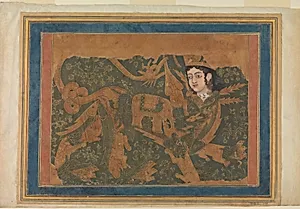
Behold *The Fabulous Creature Buraq*, a mesmerizing 17th-century folio from the Islamic Art collection at The Metropolitan Museum of Art. Created around 1660–80 by an unknown artist, this opaque watercolor and gold painting on paper captures the mythical Buraq—a legendary steed from Islamic tradition known for transporting the Prophet Muhammad during his miraculous Night Journey (Mi'raj). Measuring about 11 by 9 inches, the delicate work likely originates from a codex, a bound manuscript format prized for preserving illuminated texts and illustrations. Buraq is often depicted as a composite being blending human, equine, and fantastical elements, as seen here in its bird-like wings, elephantine features, fish scales, and expressive faces—evoking wonder and divinity. This artwork reflects the rich Persian or Mughal miniature tradition of the Safavid or early Mughal era, where artists masterfully fused spirituality with imagination to visualize sacred narratives. The technique of opaque watercolor, layered with shimmering gold, creates a luminous, jewel-like quality on paper, heightening the creature's otherworldly aura. Such pieces highlight Islamic art's emphasis on intricate detail and symbolic harmony, inviting viewers to ponder the interplay of myth, faith, and artistry in 17th-century Muslim cultures.