
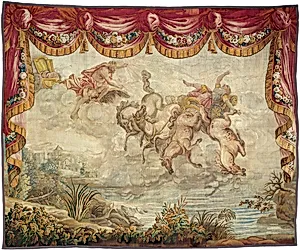
The Fall of Phaeton
after 1776
Medium
Wool and silk, slit and double interlocking tapestry weave
Dimensions
351.2 × 286.3 cm (138 1/4 × 112 3/4 in.)
Classification
weaving - tapestry
Department
Textiles
Museum
Art Institute of Chicago
Accession Number
49208
Rights
Public Domain
About this artwork
Phaeton’s overweening ambition to guide his father’s chariot of the sun through the sky is recorded in Ovid’s Metamorphoses, as is the disastrous outcome of his attempt, here presented in a dramatic scene that captures the tumultuous moment of Phaeton’s being struck down by a thunderbolt from Zeus. The scalloped valance and matching side curtains that frame the scene link it to The Arrival of Telemachus on Calypso’s Island. The two tapestries are part of a Story of Telemachus suite based on Fran...
Art Historical Context
The Fall of Pha captures a dramatic moment from Greek mythology in which the young Phaeton control of the sun god chariot, plunging toward in a blaze of fire chaos. Woven after 1776 in wool and silk using slit and double interlocking tapestry techniques, this large hanging transforms the turbulent narrative into a, tactile surface where luminous silk threads highlight the swirling horses and tumbling figure against darker woolen grounds. Antonio Tempesta, whose designs often inspired later weavers, brought dynamic energy to mythological subjects through his work in prints and paintings. Here, the tapestry medium amplifies that energy, allowing intricate details of movement and emotion to unfold across more than eleven feet of fabric. Such large-scale textiles were prized in European interiors for both their storytelling power and their ability to soften and adorn grand spaces. Now part of the Art Institute of Chicago’s textile collection, the piece invites viewers to appreciate the enduring appeal of classical myths rendered through skilled weaving. The careful interplay of color and texture preserves the story’s tension while demonstrating the artistry of tapestry production long after Tempesta’s own lifetime.
About the Artist
Antonio Tempesta · 1555–1630
Antonio Tempesta (1555–1630), known as 'Il Tempestino,' was a Florentine painter and printmaker whose extraordinary output of approximately 1,700 etchings made him one of the most influential printmakers of the early Baroque period. Born in Florence and trained under Santi di Tito and the Flemish master Joannes Stradanus, he enrolled in the Accademia del Disegno in 1576 before relocating to Rome i...