
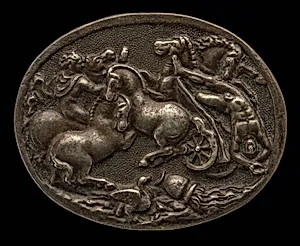
The Fall of Phaeton
mid 16th century
Medium
silver
Dimensions
overall: 4 x 4.9 cm (1 9/16 x 1 15/16 in.) gross weight: 12 gr
Classification
Sculpture
Department
CSD
Museum
National Gallery of Art, Washington, D.C.
Credit
Gift of Lisa and Leonard Baskin
Accession Number
1995.27.1
Rights
Public Domain
Art Historical Context
This exquisite silver plaquette, created in central Italy during the mid-16th century, captures the dramatic myth of Phaeton’s fall. The young son of the sun god Helios, Phaeton loses control of father’s chariot and plummets to earth after Zeus strikes him down with a thunderbolt. Measuring just four by five centimeters, the work’s compact scale highlights the remarkable skill of Renaissance metalworkers who could convey intense movement and emotion within a tiny surface. Produced “after the Antique,” the piece reflects the period’s deep fascination with classical mythology and ancient Roman art. Artists of the time often drew inspiration from engraved gems, coins, and reliefs, adapting these sources into precious materials like silver. Such objects were prized by collectors for their refined craftsmanship and ability to bring ancient stories into private cabinets of curiosity. As a gift to the National Gallery of Art from Lisa and Leonard Baskin, this sculpture offers visitors a tangible connection to Renaissance humanism. Its gleaming surface and dynamic composition remind us how classical tales of ambition and divine justice continued to resonate centuries later.