
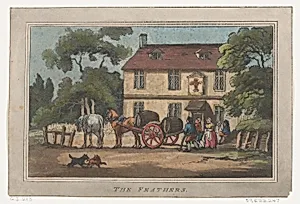
The Feathers
Medium
Etching and aquatint
Dimensions
Sheet: 6 1/8 × 9 1/8 in. (15.6 × 23.2 cm)
Classification
Prints
Department
Drawings and Prints
Museum
Metropolitan Museum of Art, New York, NY
Credit
The Elisha Whittelsey Collection, The Elisha Whittelsey Fund, 1959
Accession Number
59.533.247
Rights
Public Domain
Tags
Art Historical Context
Thomas Rowlandson's *The Feathers* (1787) captures a lively slice of late Georgian England through the lens of satire. This etching and aquatint a bustling urban scene featuring men, women, horses, and carriages what appears to be a tavern or inn—likely named for its feathered sign, a common motif in British public houses. Rowlandson, a master caricaturist known for his humorous and often bawdy commentary on social vices, skewers the era's upper classes and their indulgences with exaggerated figures and chaotic energy. The medium of etching combined with aquatint was revolutionary for printmakers like Rowlandson. Etching provided crisp lines for sharp details, while aquatint added rich, tonal washes mimicking watercolor effects, allowing for atmospheric depth in small-scale works like this 6⅛ × 9⅛ sheet. This technique made his prints affordable and widely circulated, amplifying their social critique during time of rapid urbanization and class tensions in London. Housed in the Metropolitan Museum of Art's Drawings and Prints department, *The Feathers* exemplifies Rowlandson's enduring appeal: a witty window into 18th-century life, where revelry meets ridicule. Visitors will delight in spotting the cheeky details that reveal the artist's keen eye for human folly.
About the Artist
Thomas Rowlandson · 1756–1827
Thomas Rowlandson (1757–1827) was an English artist and caricaturist whose satirical watercolors and prints captured the social life of Georgian Britain with unparalleled wit and technical mastery. Alongside James Gillray, he is recognized as one of the greatest British graphic artists, and his distinctive flowing line and keen observations have made his work integral to understanding late 18th an...