
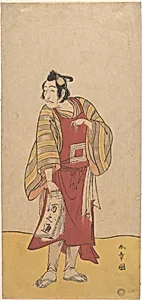
The Fifth Ichikawa Danjuro as a Man Standing
ca. 1775
Medium
Woodblock print (nishiki-e); ink and color on paper
Dimensions
12 1/2 x 5 13/16 in. (31.8 x 14.8 cm)
Classification
Prints
Culture & Period
Japan · Edo period (1615–1868)
Department
Asian Art
Museum
Metropolitan Museum of Art, New York, NY
Credit
Purchase, Joseph Pulitzer Bequest, 1918
Accession Number
JP416
Rights
Public Domain
Tags
Art Historical Context
Katsukawa Shunshō *The Fifth Ichikawa Danjūrō as a Man Standing* (ca. 1775) is a striking woodblock print (nishiki-e) from Edo period (16151868), capturing the of kabuki theater. The Fifth Ichikawa Danjūr, from one of kabuki's most illustrious acting lineages, poses dramatically in a role that highlights his commanding presence. Measuring just 12½ x 5⅞ inches, this intimate portrait exemplifies the ukiyo-e ("pictures of the floating world") tradition, which celebrated everyday pleasures like theater amid urban Edo's vibrant culture. Shunshō, a master of the Katsukawa school, specialized in yakusha-e—detailed actor portraits that brought kabuki stars to life for everyday fans. Nishiki-e technique, perfected in the 1760s, allowed for lush, multicolored layers through intricate woodblock carving and precise color registration, mimicking luxurious brocade fabrics. This innovation made prints affordable and wildly popular, turning actors into celebrities. Housed in the Metropolitan Museum of Art's Asian Art collection, this work underscores kabuki's cultural dominance and the woodblock print's role in democratizing art. It invites viewers to step into Edo's theatrical world, where a single pose conveyed epic stories.
About the Artist
Katsukawa Shunshō 勝川春章 (Japanese) · 1726 –1792
Japanese, 1726–1792