
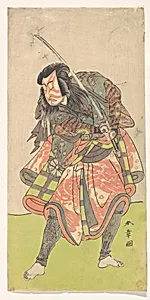
The First Nakamura Tomijuro as an Outlaw
ca. 1775
Medium
One sheet of a diptych or triptych of woodblock prints (nishiki-e); ink and color on paper
Dimensions
12 x 5 7/8 in. (30.5 x 14.9 cm)
Classification
Prints
Culture & Period
Japan · Edo period (1615–1868)
Department
Asian Art
Museum
Metropolitan Museum of Art, New York, NY
Credit
Purchase, Joseph Pulitzer Bequest, 1918
Accession Number
JP413
Rights
Public Domain
Tags
Art Historical Context
Step into the vibrant world of Edo-period Japan with *The First Nakamura Tomijūrō as an Outlaw*, a stunning woodblock print by master ukiyo-e artist Katsukawa Shunshō (1726–1792). Created around 1775, this single sheet from a diptych or triptych—measuring just 12 x 5⅞ inches—captures the legendary kabuki actor Nakamura Tomijūrō I in a dramatic outlaw role. Rendered in nishiki-e (brocade print) technique with ink and vibrant colors on paper, it showcases Shunshō's expertise in yakusha-e, or actor portraits, which immortalized theater stars for everyday fans. Shunshō, a pivotal figure in the Katsukawa school, elevated ukiyo-e ("pictures of the floating world") by blending precise lines with dynamic poses, here emphasizing the actor's fierce expression and sword-wielding stance—hallmarks of kabuki's theatrical intensity. During the Edo period (1615–1868), such prints democratized celebrity culture, allowing urbanites to own affordable glimpses of onnagata (female impersonators) like Tomijūrō, who specialized in bold, villainous parts. This Met masterpiece, acquired in 1918, highlights nishiki-e's technical marvel: multiple woodblocks layered for rich hues and subtle gradients, evoking the stage's glamour. It invites us to ponder kabuki's enduring role in Japanese identity, where art and performance blurred lines between fiction and fervor.
About the Artist
Katsukawa Shunshō 勝川春章 (Japanese) · 1726 –1792
Japanese, 1726–1792