
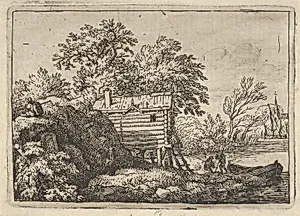
The Fisherman's Hut
Medium
Engraving; first state of three
Dimensions
Plate: 2 15/16 × 4 1/4 in. (7.5 × 10.8 cm) Sheet: 3 3/8 × 4 1/2 in. (8.5 × 11.5 cm)
Classification
Prints
Department
Drawings and Prints
Museum
Metropolitan Museum of Art, New York, NY
Credit
Rogers Fund, 1920
Accession Number
20.24.13
Rights
Public Domain
Tags
Art Historical Context
Allart van Everding (1601–1675), a prominent Dutch Golden Age artist, captured the rugged beauty of northern landscapes in *The Fisherman's Hut*, an evocative engraving from the first state of three. This intimate print (plate: 2 15/16 × 4 1/4 in.) depicts a humble fisherman's shelter amid boats and coastal buildings, evoking the stark, windswept shores Everdingen encountered during his travels to Sweden Norway in the 1640s. His works introduced Scandinavian motifs—craggy rocks, wooden huts, and hardy seafarers—to Dutch art, blending them with the dramatic realism of the Baroque era. As an engraving, this piece showcases meticulous line work, where fine incisions into a metal plate create rich tonal contrasts and texture, allowing for multiple impressions. The "first state" refers to its unaltered edition before later revisions, making it a prized rarity for collectors, acquired by The Metropolitan Museum of Art via the Rogers Fund in 1920. Everdingen's prints popularized his Nordic visions, influencing later Romantic landscapists and bridging everyday maritime life with poetic wilderness. Today, this tiny yet powerful work invites visitors to ponder the resilience of coastal dwellers, a timeless theme in 17th-century European printmaking.
About the Artist
Allart van Everdingen · 1621–1675
Allaert van Everdingen (1621-1675) was a Dutch Golden Age painter and printmaker who introduced Scandinavian landscape painting to the Netherlands. Born in Alkmaar and baptized on June 18, 1621, he pioneered a distinctive genre of Nordic mountain scenery that profoundly influenced Dutch landscape painting and later inspired the Romantic movement. Van Everdingen holds a unique place in art history...