
The Five Points
Unknown Artist
ca. 1827?
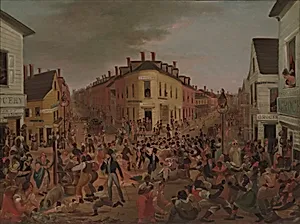
Medium
Oil on wood panel
Classification
Painting
Culture
American
Department
The American Wing
Museum
Metropolitan Museum of Art, New York, NY
Credit
Bequest of Mrs. Screven Lorillard (Alice Whitney), from the collection of Mrs. J. Insley Blair, 2016
Accession Number
2016.797.17
Rights
Public Domain
Tags
Art Historical Context
*The Five Points*, an oil painting on wood panel from around 1827, offers a rare glimpse into early 19th-century New York City life. Created by an unknown American artist, this work captures the bustling chaos of the infamous Five Points neighborhood—a notorious slum in lower Manhattan where Worth, Baxter, and Park converged. The scene teems with men, women, and crowds tightly packed buildings and gritty streets, evoking the energy of a rapidly urbanizing America. Historically, Five Points symbolized the era's stark social contrasts: waves of Irish and other immigrants poured into overcrowded tenements amid poverty, crime, and disease, making it a focal point for reformers like Jacob Riis decades later. This painting, housed in the Metropolitan Museum of Art's American Wing, preserves that gritty reality just as the neighborhood emerged, predating its peak notoriety in the 1840s–50s. The choice of oil on wood panel suggests a modest, intimate format suited for detailed genre scenes, allowing the artist to render textures of weathered facades and lively figures with precision. Bequeathed in 2016 from distinguished collections, it stands as a poignant artifact of America's urban transformation, inviting visitors to ponder the human stories behind the city's foundations.