
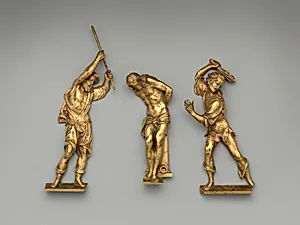
The flagellation of Christ
Giambologna, mid-17th century
About this artwork
Behold *The Flagellation of Christ*, a striking gilt bronze sculpture attributed to Giambologna, renowned Florentine artist active in the Mannerist tradition. Dating to the mid-17th century, this intimate group comprises three figures—likely Christ at the center (5 7/8 inches high) flanked by his tormentors (9 inches and 7 1/4 inches)—capturing the raw intensity of the biblical scourging scene. The gilded bronze medium, with its warm luster and fine detailing, was a hallmark of Italian Renaissance and Baroque workshops, ideal for both devotional use and princely collections. Giambologna's workshop excelled in such small-scale bronzes, blending anatomical grace with dramatic torsion to evoke pathos and movement. This piece reflects Florence's enduring legacy in religious sculpture during the Counter-Reformation era, when vivid depictions of Christ's Passion stirred piety and emotional devotion among viewers. Its dynamic poses heighten the viewer's empathy, transforming a tabletop object into a profound meditation on suffering and redemption. Now part of The Metropolitan Museum of Art's European Sculpture and Decorative Arts collection, gifted through The Friedsam Collection in 1931, it exemplifies the technical virtuosity and spiritual depth of Italian art, inviting modern visitors to ponder its timeless narrative.