
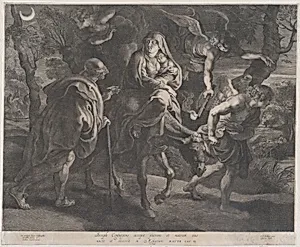
The Flight into Egypt
Medium
Engraving; second or third state of three
Dimensions
Sheet (Trimmed): 14 15/16 × 18 1/8 in. (38 × 46.1 cm)
Classification
Prints
Department
Drawings and Prints
Museum
Metropolitan Museum of Art, New York, NY
Credit
The Elisha Whittelsey Collection, The Elisha Whittelsey Fund, 1951
Accession Number
51.501.7067
Rights
Public Domain
Tags
Art Historical Context
This engraving captures the biblical Flight into Egypt, a poignant moment when the Holy Family—Mary, Joseph, and the infant Jesusflees to safety. Created between 1620 and 1640, the work reflects the enduring popularity of this narrative in Christian art, emphasizing themes of protection, faith, and divine guidance. The composition highlights the Madonna and Child accompanied by angels, rendered with a sense of gentle movement and quiet drama typical of the Baroque period. Peter Paul Rubens, whose designs often inspired such prints, was a leading Flemish Baroque master known for his dynamic figures and emotional intensity. Here, the engraving technique—likely executed by Ignatius Cornelis Marinus after a Rubens composition—translates those qualities into fine, precise lines on paper. As a second or third state of three, this impression reveals the careful refinement of the plate during production, allowing subtle adjustments to shading and detail. Prints like this played a vital cultural role in the 17th century, making celebrated religious imagery widely available beyond church walls or private collections. Housed in the Metropolitan Museum of Art’s Department of Drawings and Prints, the work invites viewers to appreciate both the spiritual story and the masterful craftsmanship that preserved it for generations.
About the Artist
Ignatius Cornelis Marinus|Peter Paul Rubens (Flemish|Flemish) · 1577 |1599 –1640 |1639
Flemish, Siegen 1577–1640 Antwerp|Flemish, London 1599–1639 Antwerp