
The Flight into Egypt
1601 to 1650
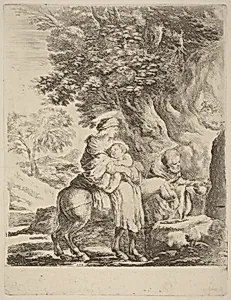
Medium
etching on laid paper [restrike]
Classification
Department
CG-E
Museum
National Gallery of Art, Washington, D.C.
Credit
Transferred from The Library of Congress
Accession Number
1986.50.32
Rights
Public Domain
Art Historical Context
Stefano della Bella's *The Flight into Egypt*, created between 1601 and 1650, captures a pivotal biblical moment from the Gospel of Matthew: the Holy Family's hurried escape from King Herod's massacre of the innocents. As a masterful Italian etcher of the Baroque era, della Bella (1610–4) excelled in intricate, atmospheric prints that blended narrative drama with landscape elements, influenced by masters like Jacques Callot and Rembrandt. This work exemplifies his skill in depicting motion and emotion amid rugged terrain, inviting viewers to ponder the vulnerability and divine protection of Mary, Joseph, and the Christ child. Rendered as an etching on laid paper—a restrike from the original copper plate—this print highlights the technical brilliance of 17th-century intaglio printing. Etching allowed della Bella to achieve fine, expressive lines with acid-etched depth, producing rich tonal contrasts on the textured laid paper, which features visible chain lines from its handmade production. Restrikes, like this one transferred from the Library of Congress to the National Gallery of Art's CG-E department, extended the life of such plates, making Baroque artistry accessible to later generations. Housed in the National Gallery of Art, this print reflects the era's Counter-Reformation fervor, where religious imagery reinforced faith through vivid storytelling. Della Bella's oeuvre, including pastoral scenes and equestrian motifs from his time in Paris and Florence, underscores his role in elevating printmaking to fine art, bridging Italy's grand manner with Northern precision.
About the Artist
Stefano Della Bella · 1610–1664
Stefano della Bella (1610-1664) was one of the most prolific and versatile printmakers of the Italian Baroque period, leaving behind 1,052 prints and several thousand drawings that captured the vivid essence of 17th-century European life. Born in Florence on May 18, 1610, to a family of artists, he trained initially as a goldsmith before studying painting under Cesare Dandini and etching under Rem...