
The Florentine Duomo
1869–70
Medium
Etching on ivory laid paper
Dimensions
Image: 23 × 15 cm (9 1/16 × 5 15/16 in.); Plate: 24 × 15.8 cm (9 1/2 × 6 1/4 in.); Sheet: 31.2 × 19.5 cm (12 5/16 × 7 11/16 in.)
Classification
etching
Department
Prints and Drawings
Museum
Art Institute of Chicago
Accession Number
43164
Rights
Public Domain
About this artwork
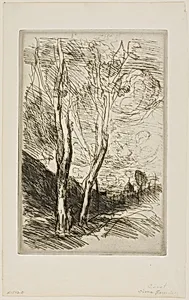
A prolific painter who also produced etchings and cliché-verre prints, Jean-Baptiste-Camille Corot visited the countryside of Florence many times in paint and in print. On an early trip to Italy in 1834, he painted a view of the Florentine cathedral dome from the terraces of the Boboli Gardens to the north of the city. This print features a similar—though simplified—version of the prospect, with the leftmost trees most prominent. An avid student of nature, Corot preceded the Impressionists in st...
Art Historical Context
Jean-Baptiste-Camille Corot’s *The Florentine Duomo* (1869–70) captures the soaring silhouette of Florence’s famed cathedral, Santa Maria del Fiore, with its iconic dome designed by Filippo Brunelleschi. Created late in Corot’s career this etching reflects the artist enduring fascination with Italian architecture, drawn from earlier travels even as he worked primarily in France. Known for his luminous landscapes and role as a bridge between Neoclassicism and Impressionism, Corot here turns his sensitive eye toward monumental form rather than open countryside. The medium of etching on ivory laid paper allowed Corot to achieve delicate tonal gradations and crisp architectural lines through the intaglio process, where acid bites into the plate to hold ink. This printmaking technique suited his desire to convey both the massive scale of the Duomo and the subtle play of light across its surfaces. As a work on paper from the Art Institute of Chicago’s Prints and Drawings collection, it highlights Corot’s skill in translating painterly atmosphere into the graphic arts during a period when etching experienced renewed interest among French artists.