
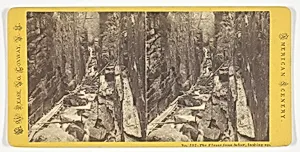
The Flume from below, looking up
Mid 19th century
Medium
Albumen print, stereo
Dimensions
Each image: 8 × 7.7 cm (3 3/16 × 3 1/16 in.); Card: 8.6 × 17.5 cm (3 7/16 × 6 15/16 in.)
Classification
photography
Department
Photography and Media
Museum
Art Institute of Chicago
Accession Number
199677
Rights
Public Domain
Art Historical Context
Step into the dramatic depths of nature with *The Flume from below, looking up*, a captivating mid-19th-centuryoscopic albumen print by N. W. Pease. This intimate yet awe-inspiring view captures a flume—a narrow, rocky chasm carved by rushing water—from a low vantage point, gazing upward to emphasize the towering walls and cascading flow. Pease, an early photographer, masterfully documents America's natural wonders during an era when scenic tourism was booming, inviting viewers to experience remote landscapes up close. The artwork's medium is a stereo albumen print, consisting of two nearly identical images (each 8 × 7.7 cm) mounted side-by-side on a 8.6 × 17.5 cm card. Albumen, made from egg whites coated on paper with silver salts, was the gold standard for sharp, richly toned photographs from the 1850s onward. Viewed through a stereoscope, the paired images create a vivid three-dimensional effect, revolutionizing how people "traveled" via photography in parlors worldwide. Housed in the Art Institute of Chicago's Photography and Media Department, this piece exemplifies the artistic and cultural shift toward documenting the sublime in nature. It highlights photography's role in preserving ephemeral beauty and fueling public fascination with the American wilderness, bridging art and science in the 19th century.