
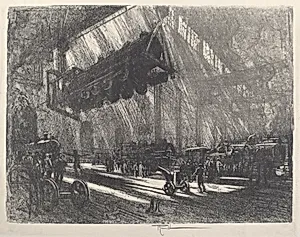
The Flying Locomotive
1917
Medium
lithograph
Classification
Department
CG-W
Museum
National Gallery of Art, Washington, D.C.
Credit
Rosenwald Collection
Accession Number
1943.3.7284
Rights
Public Domain
Art Historical Context
**The Flying Locomotive** is a striking 1917 lithograph by Pennell, a leading American printmaker renowned for his dynamic portrayals of modern industry and architecture. Created during World War I, this print captures the era's fascination with speed and technological prowess, embodying the locomotive as a symbol of human ingenuity and progress. Pennell's bold composition likely hurtles viewers into the thrill of motion, with the train hurtling forward amid swirling smoke and energy. As a master of lithography—a planographic printing technique that allowed for intricate tonal gradations and expressive lines—Pennell produced over 900 prints in his career, often celebrating the monumental achievements of the industrial age. His style, influenced by the Arts and Crafts movement and contemporaries like Whistler, emphasized dramatic contrasts and a sense of scale, making everyday machinery feel epic and alive. This work exemplifies his ability to transform mechanical subjects into visual spectacles. Housed in the National Gallery of Art's Rosenwald Collection (Department CG-W), **The Flying Locomotive** invites visitors to reflect on how art documented the transformative power of railroads in early 20th-century America. A testament to Pennell's skill, it reminds us of the beauty found in the roar of progress. (198 words)
About the Artist
Joseph Pennell · 1857–1926
Joseph Pennell (1857–1926) was born in Philadelphia to Quaker parents and displayed an early aptitude for drawing, finding solace in sketching amid a challenging childhood. He received initial drawing instruction from James R. Lambdin and his first etching lessons from Stephen Ferris in 1879. Pennell attended night classes at the Pennsylvania Museum and School of Industrial Art before studying at ...