
The Forge
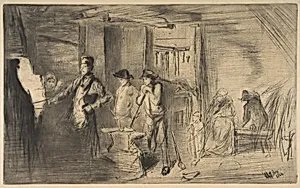
Medium
Drypoint, printed in black ink on cream wove paper; sixth state of six (Glasgow)
Dimensions
Plate: 7 5/8 × 12 7/16 in. (19.4 × 31.6 cm) Sheet: 8 7/8 × 13 11/16 in. (22.5 × 34.8 cm)
Classification
Prints
Department
Drawings and Prints
Museum
Metropolitan Museum of Art, New York, NY
Credit
Harris Brisbane Dick Fund, 1917
Accession Number
17.3.53
Rights
Public Domain
Tags
Art Historical Context
James McNeill Whistler’s *The Forge* (1861) captures the gritty intensity of industrial labor through the intimate medium of drypoint, a technique where the artist scratches directly into a metal plate to create rich, textured lines from the burr raised by the tool. Printed in black ink on cream wove paper, sixth and final state from the Glasgow edition showcases Whistler’s mastery of subtle tonal variations and atmospheric depth, evoking the heat and haze of a blacksmith’s workshop. Measuring just 7⅝ × 12⅞ inches on the plate, its modest scale invites close viewing, revealing the men at work—likely ironworkers hammering glowing metal—in a scene alive with movement and shadow. Whistler, an American expatriate in London, was a pioneer of the 19th-century Etching Revival, blending Realism with emerging Aesthetic principles that prioritized “art for art’s sake.” *The Forge* reflects his fascination with everyday urban life, influenced by his Thames-side observations, and marks an early pinnacle of his printmaking innovation. By progressively reworking plates across states, he refined compositions for maximum expressive power, making each impression a unique artwork. Acquired through the Harris Brisbane Dick Fund in 1917, this print from the Metropolitan Museum of Art’s Drawings and Prints collection highlights Whistler’s enduring influence on modern printmaking, bridging Victorian industry with artistic elegance.
About the Artist
James McNeill Whistler · 1834–1903
James Abbott McNeill Whistler (1834-1903) was an American-born painter and printmaker who became a leading figure in the Aesthetic Movement and pioneer of Tonalism and Japonisme. He revolutionized art by championing "art for art's sake" and treating paintings as visual equivalents of musical compositions, titling works as "arrangements," "harmonies," and "nocturnes" to emphasize formal qualities o...