
The Forge
17th century
Medium
Etching; second state of two
Dimensions
7.9 x 10.6 cn
Classification
Prints
Department
Drawings and Prints
Museum
Metropolitan Museum of Art, New York, NY
Credit
Purchase, Joseph Pulitzer Bequest, 1917
Accession Number
17.50.15-232
Rights
Public Domain
Tags
Art Historical Context
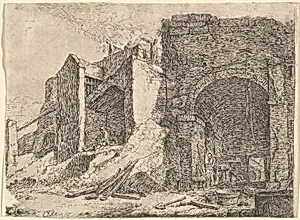
Thomas Wijck, a Dutch artist active during the Golden Age of the 17th century, captures the gritty intensity of everyday labor in *The Forge*, a delicate etching measuring just 7.9 x 10.6 cm. Produced as the second state of two—a refined version likely featuring subtle enhancements to lines or shading—this print exemplifies the era's fascination with genre scenes depicting ordinary trades like blacksmithing. Housed in the Metropolitan Museum of Art's Drawings and Prints department, entered the collection through the Joseph Pulitzer Bequest in 1917. Etching, Wijck's chosen medium, allowed for intricate details through acid-bitten lines on a metal plate, enabling precise renderings of flickering flames, billowing smoke, and sturdy workshop architecture—hinted at by the "Buildings" tag. This technique was revolutionary for its accessibility, letting affordable prints disseminate vivid snapshots of Dutch life to a wide audience beyond oil paintings. *The Forge* offers a window into 17th-century Europe's industrial underbelly, romanticizing the blacksmith's domain amid the Netherlands' prosperous trade era. Wijck's work, influenced by Haarlem's genre tradition, celebrates manual craft while showcasing the built environment's role in daily toil, inviting us to appreciate the artistry in the commonplace.
About the Artist
Thomas Wijck · 1616–1677
**Thomas Wijck** (also spelled Wijk or Wyck; 1616–1677) was a Dutch Golden Age painter renowned for his Italianate port scenes, genre paintings, and depictions of alchemists and scholars. Born in Beverwijk into an artist family, he received his initial training from his father before traveling to Italy around 1640. There he spent time in Rome and the environs of Naples, producing numerous sketches...