
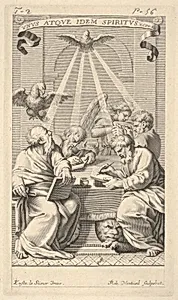
The Four Evangelists
Medium
Engraving; third state of five (Petitjean & Wickert)
Dimensions
Sheet: 6 3/8 × 4 in. (16.2 × 10.1 cm) Plate: 5 9/16 × 7 5/16 in. (14.2 × 18.5 cm)
Classification
Prints
Department
Drawings and Prints
Museum
Metropolitan Museum of Art, New York, NY
Credit
Harris Brisbane Dick Fund, 1917
Accession Number
17.3.1987
Rights
Public Domain
Tags
Art Historical Context
In the heart of 17th-century French Baroque, *The Four Evangelists*ca. 1653) captures a timeless religious theme through the masterful collaboration of painter Eustache Le Sueur engraver Robert Nante. Le Sueur, a leading figure in the classical Baroque style, likely designed the original composition depicting Saints Matthew, Mark, Luke, and John— symbolized by traditional emblems: the angel or man for Matthew, lion for Mark, ox (implied in avian motifs), and eagle (as birds) for John. Shown intently writing their Gospels amid these vivid symbols, the figures embody divine inspiration and scriptural authority. Nanteuil's engraving, in its third state of five as cataloged by Petitjean and Wickert, showcases the engraver's precision in translating Le Sueur's fluid forms onto copper plate. Measuring a compact 5 9/16 × 7 5/16 inches, this print from the Metropolitan Museum of Art's Drawings and Prints collection highlights the era's reproductive printmaking techniques, which allowed sacred imagery to reach beyond elite patrons into wider devotional circles during Louis XIV's reign. This work's cultural resonance lies in its role as both devotional aid and artistic showcase, blending spiritual symbolism with technical virtuosity. Acquired via the Harris Brisbane Dick Fund in 1917, it invites visitors to ponder how engravings democratized Baroque grandeur.
About the Artist
Robert Nanteuil|Eustache Le Sueur · 1623–1678
Robert Nanteuil (1623-1678) was a French portrait engraver, draughtsman, and pastellist who became the preeminent portraitist to the court of Louis XIV. His technical mastery and royal patronage fundamentally transformed the status of engraving in France, elevating it from a mechanical craft to a recognized fine art. Nanteuil stands as the outstanding French portrait engraver of the seventeenth c...