
The Genius of Salvator Rosa
1601 to 1650
Medium
etching
Classification
Department
CG-E
Museum
National Gallery of Art, Washington, D.C.
Credit
Ailsa Mellon Bruce Fund
Accession Number
1972.66.40
Rights
Public Domain
Art Historical Context
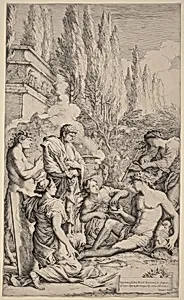
Salvator Rosa (1615–1673), a fiery Italian Baroque artist from Naples, created *The Genius of Salvator* during his prolific mid-17th-century career. This etching, housed in the National Gallery of's CG-E department and acquired through the Ailsa Mellon Bruce Fund captures the artist's self-reflective spirit. The title suggests an allegorical self-portrait, where Rosa embodies the "genius"—a muse of invention and creativity—blending personal bravado with Renaissance ideals of the artist as a heroic figure. Etching, Rosa's favored printmaking technique, allowed him unprecedented freedom. By drawing directly into a wax-grounded copper plate and biting it with acid, he achieved intricate, expressive lines that conveyed drama and movement, hallmarks of his rugged landscapes and battle scenes. Unlike smoother engravings, etchings like this one enabled a spontaneous, painterly quality, making fine art accessible beyond oil paintings and influencing later printmakers. Rosa's works rebelled against academic norms, embracing wild nature and individualism that foreshadowed Romanticism. This print not only showcases his technical virtuosity but also his cultural swagger—he often depicted himself as a philosopher-poet-warrior—offering visitors a window into the bold Baroque personality who challenged conventions in 17th-century Italy.
About the Artist
Salvator Rosa · 1615–1673
Salvator Rosa was born in 1615 in Arenella, on the outskirts of Naples, into a world of artistic ambition and turbulent talent. His early training came through his maternal uncle, the painter Paolo Greco, and his brother-in-law Francesco Fracanzano, himself a pupil of the great Spanish-born Neapolitan master Jusepe de Ribera. Rosa showed a fierce independence from the start, resisting his father's...