
The Ghost on the Terrace
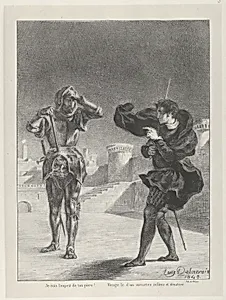
Medium
Lithograph, first state of five
Dimensions
Image: 10 3/16 x 7 1/2 in. (25.8 x 19.1 cm) Sheet: 11 7/16 x 8 7/16 in. (29 x 21.5 cm)
Classification
Prints
Department
Drawings and Prints
Museum
Metropolitan Museum of Art, New York, NY
Credit
Rogers Fund, 1922
Accession Number
22.56.7
Rights
Public Domain
Tags
Art Historical Context
Step into the dramatic world of Eugène Delacroix's *The Ghost on the Terrace (1843), a lithograph that brings a pivotal scene from William Shakespeare's *Hamlet* to life. This first-state proof captures the eerie apparition of King Hamlet's ghost confronting his son on the castle terrace, evoking the supernatural tension and moral turmoil at the heart of the tragedy. Delacroix, a master of Romanticism known for his expressive use of light, shadow, and emotion, drew inspiration from Shakespeare's timeless exploration of revenge, madness, and fate—perfectly suited to his dynamic style. Printed as one of five states, this rare lithograph (image: 10 3/16 x 7 1/2 in.) showcases the medium's revolutionary potential in the 19th century. Lithography allowed artists like Delacroix to achieve painterly effects with chalk on stone, producing rich tonal contrasts that heighten the ghostly drama. Acquired through the Rogers Fund in 1922, it's housed in the Metropolitan Museum of Art's Drawings and Prints department, highlighting its status as a gem of literary illustration. This work bridges visual art and literature, inviting visitors to ponder how Delacroix's vivid imagery amplifies Shakespeare's psychological depth, making the Bard's villains and specters feel hauntingly immediate.
About the Artist
Eugène Delacroix|William Shakespeare|Villain · 1798–1863
Eugène Delacroix (1798–1863) stands as the defining figure of French Romanticism and a pivotal bridge to modernism. Born in Charenton-Saint-Maurice near Paris, he came from distinguished lineage—his mother descended from the prestigious Oeben-Riesener furniture dynasty, while persistent speculation suggested the statesman Talleyrand may have been his biological father, a theory supported by physic...