
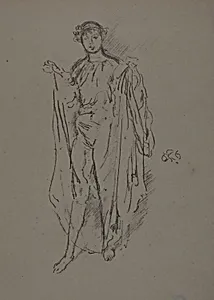
The Girl
probably 1891, printed posthumously
Medium
Transfer lithograph in black on cream laid paper
Dimensions
Image: 22.2 × 11.6 cm (8 3/4 × 4 5/8 in.); Sheet: 26.8 × 20.8 cm (10 9/16 × 8 1/4 in.)
Classification
transfer lithograph
Department
Prints and Drawings
Museum
Art Institute of Chicago
Accession Number
139469
Rights
Public Domain
Art Historical Context
James McNeill Whistler’s *The Girl*, a transfer lithograph from around 1891 and printed posthumously, captures the artist’s mastery of subtle tonal effects in printmaking. Created on cream laid paper, this work measures just 22.2 × 11.6 cm for the image, inviting viewers into a delicate portrait likely evoking everyday grace. Whistler, the American-born expatriate famed for his Aesthetic movement ideals—“art for art’s sake”—pioneered transfer lithography, drawing directly on paper that was then chemically transferred to a lithographic stone. This technique allowed painterly freedom, blending soft greys and blacks into atmospheric harmony reminiscent of his famous nocturnes and portraits. Produced late in Whistler’s career, *The Girl* reflects his experimental print series from the 1880s and 1890s, often inspired by urban life and fleeting moments. Posthumous printing after his 1903 death extended the reach of these editions, making his innovations accessible to wider audiences. Housed in the Art Institute of Chicago’s Prints and Drawings department, it exemplifies how lithography democratized fine art, bridging painting and reproduction with elegant restraint. A charming gem for print enthusiasts, *The Girl* whispers Whistler’s philosophy: beauty in simplicity, where form and mood eclipse narrative.
About the Artist
James McNeill Whistler · 1834–1903
James Abbott McNeill Whistler (1834-1903) was an American-born painter and printmaker who became a leading figure in the Aesthetic Movement and pioneer of Tonalism and Japonisme. He revolutionized art by championing "art for art's sake" and treating paintings as visual equivalents of musical compositions, titling works as "arrangements," "harmonies," and "nocturnes" to emphasize formal qualities o...