
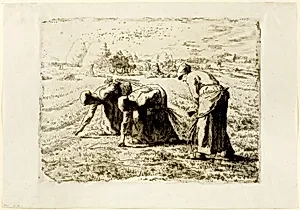
The Gleaners
1855–56
Medium
Etching and drypoint on ivory laid paper hinged to cream card
Dimensions
Image: 19.1 × 25.4 cm (7 9/16 × 10 in.); Plate: 19.1 × 25.4 cm (7 9/16 × 10 in.); Primary support: 23.5 × 33.6 cm (9 5/16 × 13 1/4 in.); Secondary support: 29.1 × 38.8 cm (11 1/2 × 15 5/16 in.)
Classification
etching
Department
Prints and Drawings
Museum
Art Institute of Chicago
Accession Number
49791
Rights
Public Domain
Art Historical Context
Jean-François Millet’s *The Gleaners* (1855–56) captures the quiet dignity of rural labor in mid-nineteenth-century France. Created during the height of the Realist movement, Millet belonged to the Barbizon school of artists who turned their attention to the French countryside and the lives of peasants. This etching and drypoint, produced just before his celebrated 1857 painting of the same subject, translates that vision into a more intimate, reproducible format. Printed on ivory laid paper, the work demonstrates Millet’s mastery of etching techniques. Drypoint lines add rich texture to the figures’ clothing and the harvested field, while the restrained tonal range evokes the golden light of late summer. At roughly 19 by 25 centimeters, the modest scale invites close looking, rewarding viewers with subtle details of posture and gesture that convey both the physical effort and quiet resilience of the gleaners. Housed today in the Art Institute of Chicago’s Prints and Drawings department, this impression highlights how Millet used printmaking to extend the reach of his socially conscious imagery. The work remains a powerful reminder of the dignity found in everyday agricultural labor during an era of rapid industrialization.