
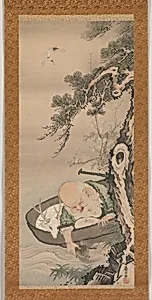
曽我蕭白筆 寿老人図|The God of Good Fortune Jurōjin
ca. 1773
Medium
Hanging scroll; ink and color on paper
Dimensions
Image: 52 3/4 x 22 5/16 in. (134 x 56.7 cm) Overall with mounting: 81 1/2 x 28 1/2 in. (207 x 72.4 cm) Overall with knobs: 81 1/2 x 30 3/4 in. (207 x 78.1 cm)
Classification
Paintings
Culture & Period
Japan · Edo period (1615–1868)
Department
Asian Art
Museum
Metropolitan Museum of Art, New York, NY
Credit
Fishbein-Bender Collection, Gift of T. Richard Fishbein and Estelle P. Bender, 2011
Accession Number
2011.572.1
Rights
Public Domain
Tags
Art Historical Context
In the vibrant Edo period (1615–1868), Japanese artist Soga Shōhaku (1739–1781) created this striking hanging scroll, *The God of Good Fortune Jurōjin* (ca. 1773). Shōhaku, renowned for his eccentric and dynamic style blending ukiyo-e woodblock influences with bold, expressive brushwork, depicted Jurōjin—one of the beloved Seven Lucky Gods (Shifukujin)—as a symbol of longevity and wisdom. Often shown with a tall forehead and staff, Jurōjin here shares the scene with auspicious companions: cranes for long life, deer for prosperity, turtles for endurance, and perhaps a boat evoking safe journeys, all rendered in vivid ink and color on paper. Hanging scrolls like this were prized in Japanese homes and temples, unrolled for special occasions to invoke blessings. Shōhaku's technique stands out for its vigorous lines and imaginative composition, departing from refined courtly traditions to embrace a wild, almost otherworldly energy that captivated Edo audiences. This work exemplifies his mastery in capturing the divine with dramatic flair. Now in the Metropolitan Museum of Art's Asian Art collection (gift of the Fishbein-Bender Collection, 2011), *Jurōjin* invites visitors to ponder Japan's rich folklore, where art and spirituality intertwined to wish health and fortune upon all.
About the Artist
Soga Shōhaku · 1730–1781
Japanese, 1730–1781