
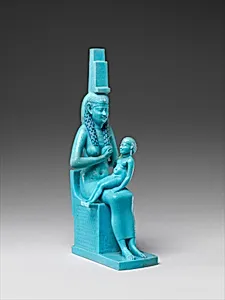
The Goddess Isis and her Son Horus
Unknown Artist
332–30 B.C.
Medium
Faience
Dimensions
H. 17 cm (6 11/16 in); W. 5.1 cm (2 in.); D. 7.7 cm (3 1/16 in.)
Classification
Statuette of Isis with the Horus child
Period
Ptolemaic Period
Department
Egyptian Art
Museum
Metropolitan Museum of Art, New York, NY
Credit
Purchase, Joseph Pulitzer Bequest Fund, 1955
Accession Number
55.121.5
Rights
Public Domain
Tags
Art Historical Context
This charming faience figurine from Egypt's Ptolemaic Period332–30 B.C.) depicts the goddess Isis tenderly nursing her son Horus, a beloved motif symbolizing maternal protection, fertility, and divine kingship Crafted during the era of Greek rule following Alexander the Great's conquest such small sculptures blended enduring Egyptian religious traditions with Hellenistic, serving as personal amlets or votive offerings homes and temples. At just 17 cm tall, piece would have been portable, offering everyday worshippers a tangible connection to Isis, the powerful sorceress-mother who resurrected her husband Osiris and safeguarded Horus from his uncle Set. Faience, a glazed composite of quartz, lime, and clay fired to a brilliant turquoise hue, was prized for its vivid color evoking the Nile's life-giving waters and lapis lazuli. The medium's glossy finish and durability made it ideal for mass-produced devotional objects, highlighting Ptolemaic artisans' skill in mold-making and glazing techniques. Now housed in the Metropolitan Museum of Art's Egyptian Art Department, acquired through the Joseph Pulitzer Bequest Fund in 1955, this artifact invites us to marvel at ancient Egypt's enduring reverence for family bonds and cosmic order.