
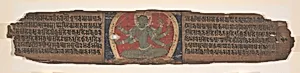
The Goddess Mahasitavati, Folio from a Buddhist Manuscript
Unknown Artist
ca. 12th century
Medium
Opaque watercolor on palm leaf
Dimensions
2 1/16 x 10 3/4 in. (5.3 x 27.3 cm)
Classification
Paintings
Culture & Period
Nepal · Karnata-Malla period
Department
Asian Art
Museum
Metropolitan Museum of Art, New York, NY
Credit
Gift of Arnold and Susan Lieberman, 1987
Accession Number
1987.246
Rights
Public Domain
Tags
Art Historical Context
Behold *The Goddess Mahasitavati, Folio from a Buddhist Manuscript*, exquisite 12th-century treasure from Nepal's Karnataalla period. This slender painting captures the fierce yet protective Buddhist goddess Mahasitavati, a tantric deity revered in Vajrayana traditions for her role in spiritual protection and enlightenment. Crafted during a golden age of Nepalese art under Malla dynasty influences from southern India, it reflects the vibrant fusion of Hindu and Buddhist iconography in the Kathmandu Valley, where such illuminated manuscripts preserved sacred texts for monastic use. Rendered in opaque watercolor on palm leaf—a traditional South Asian medium prized for its durability and portability—the artwork's elongated format (just over 10 inches long but only 2 inches high) allowed multiple folios to form illustrated narratives when bound together. The bold colors and intricate details, typical of Newar Buddhist painting, highlight the goddess's dynamic form, emphasizing her multi-armed, fierce expression symbolizing the triumph of wisdom over ignorance. Palm leaves, naturally inscribed and painted, were often perfumed and gilded, making these manuscripts both devotional objects and artistic masterpieces. Housed in the Metropolitan Museum of Art's Asian Art Department through a generous gift from Arnold and Susan Lieberman in 1987, this folio invites visitors to marvel at Nepal's medieval artistic devotion, bridging ancient spirituality with timeless beauty.