
The Golf Player
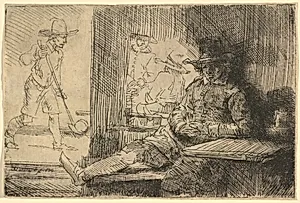
Medium
etching
Dimensions
sheet: 9.7 x 14.6 cm (3 13/16 x 5 3/4 in.)
Classification
Department
CG-E
Museum
National Gallery of Art, Washington, D.C.
Credit
Rosenwald Collection
Accession Number
1943.3.7217
Rights
Public Domain
Art Historical Context
Step into the 17th-century world of van Rijn with *The Golf Player* (1654), a etching from the National Gallery Art's Rosenwald Collection Created during Rembrandt's mature period in Amsterdam, when he was at the height of his fame as a Baroque master, this intimate print measures just 9.7 x 14.6 cm—small enough to fit in the palm of your hand.ching allowed Rembrandt to explore unprecedented depth and texture on copper plates, using acid to bite intricate lines that capture light, shadow, and movement with astonishing realism. Rembrandt's genius shines in his innovative etching techniques, layering aquatint-like effects and cross-hatching to evoke three-dimensionality in this everyday scene. Far from his biblical or portrait subjects, this work depicts a golfer mid-swing, highlighting the Dutch passion for *kolf*—a precursor to modern golf, popular among burghers in the Netherlands. It's a rare glimpse into leisure activities, blending Rembrandt's psychological insight with technical virtuosity. As a print, *The Golf Player* was designed for wide dissemination, making high art accessible. Today, it reminds us of Rembrandt's versatility, transforming a simple sport into a study of human grace and the fleeting joy of play. (198 words)
About the Artist
Rembrandt van Rijn · 1606–1669
Rembrandt Harmenszoon van Rijn (1606–1669) stands as one of the greatest visual artists in the history of Western art and the most important Dutch painter of the 17th century. Born in Leiden to a prosperous miller's family, Rembrandt transformed painting through his revolutionary use of light and shadow, his psychological depth in portraiture, and his elevation of etching to a fine art. His approx...