
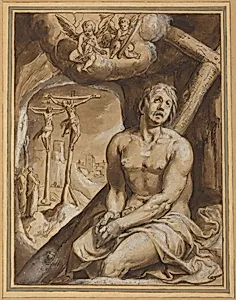
The Good Thief
1501 to 1550
Medium
pen and brown ink with brown and (orange?) wash, heightened with white
Dimensions
overall: 18.8 x 14.4 cm (7 3/8 x 5 11/16 in.)
Classification
Drawing
Department
CG-E
Museum
National Gallery of Art, Washington, D.C.
Credit
Ailsa Mellon Bruce Fund
Accession Number
1971.47.2
Rights
Public Domain
Art Historical Context
Karel van Mander I’s *The Good Thief* captures a poignant moment from the biblical Passion, depicting the repentant criminal crucified alongside Christ. Created between 1501 and 1550, this intimate drawing reflects the Northern Renaissance interest in religious narratives that emphasized human emotion and redemption. As a preparatory or independent work, it invites viewers to contemplate themes of faith and forgiveness central to Christian devotion during this period. The artist employs pen and brown ink with layered brown and orange washes, heightened with white, to create dramatic contrasts of light and shadow within a compact 18.8 by 14.4 cm format. This technique allows for expressive line work and subtle tonal modeling, giving the figure a sculptural presence despite the drawing’s modest size. Such methods were prized in 16th-century workshops for their ability to convey both spiritual intensity and anatomical detail. Housed in the National Gallery of Art through the Ailsa Mellon Bruce Fund, the work exemplifies the refined draftsmanship of early modern Europe. Its small scale suggests it may have served as a study or devotional object, offering modern audiences a direct connection to the artistic and spiritual concerns of its time.