
The Grand Tournament: The Combat
1627
Medium
Etching in black on ivory laid paper
Dimensions
Plate: 15.3 × 24.3 cm (6 1/16 × 9 5/8 in.); Sheet: 17.2 × 25.9 cm (6 13/16 × 10 1/4 in.)
Classification
Department
Prints and Drawings
Museum
Art Institute of Chicago
Accession Number
111417
Rights
Public Domain
About this artwork
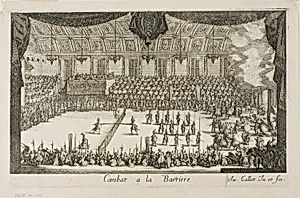
Jacques Callot produced lively etched illustrations for lavish festival books celebrating the Medici in Florence and, later, for the Duchy of Lorraine. This book, called The Combat at the Barrier after its culminating event, was held in Nancy on February 14, 1627, to honor the controversial Duchess of Chevreuse. Callot’s patron, Charles IV, Duke of Lorraine, was so smitten with her that he sided with the English against France at her request. The event consisted of an elaborate parade complete w...
Art Historical Context
Jacques Callot's *The Grand Tournament: The* (1627) captures the thrill of a chivalric spectacle at the court of the Duke of Lorraine. This etching, part of a renowned series depicting a lavish tournament held in Nancy, France, showcases armored knights clashing in mock battle amid cheering crowds. Created during the Baroque era, amid the tensions of the Thirty Years', it evokes a nostalgic ideal of medieval pageantry, blending festivity with the era's martial spirit. As a master etcher, Callot revolutionized printmaking with his intricate technique on ivory laid paper, using fine lines to render bustling scenes with remarkable clarity and depth. The plate measures 15.3 × 24.3 cm, allowing for exquisite detail in the 1,500 figures across the series—horses rearing, lances splintering, and spectators in period finery. Etching's precision enabled wide dissemination of such grandeur, making elite entertainments accessible to a broader audience. Housed in the Art Institute of Chicago's Prints and Drawings Department, this work highlights Callot's legacy in documenting 17th-century European culture, offering visitors a window into the opulent rituals of power and performance.
About the Artist
Jacques Callot · 1592–1635
Jacques Callot (1592–1635) was a French printmaker and draftsman from the Duchy of Lorraine, widely regarded as one of the first great artists to practice the graphic arts exclusively. His more than 1,400 etchings chronicled the breadth of 17th-century life, from Medici court festivities to the brutal realities of warfare. Callot revolutionized etching through technical innovations including the é...