
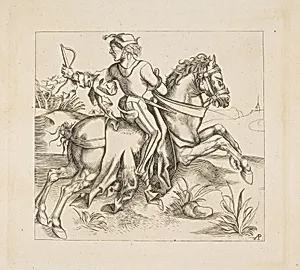
The Great Courier (copy)
19th century
Medium
Engraving
Dimensions
Plate: 3 15/16 × 4 5/16 in. (10 × 11 cm)
Classification
Prints
Department
Drawings and Prints
Museum
Metropolitan Museum of Art, New York, NY
Credit
Fletcher Fund, 1919
Accession Number
19.73.93
Rights
Public Domain
Tags
Art Historical Context
Behold *The Great Courier (copy)*, a 19th-century engraving by Alois Petrak after the Renaissance master Albrecht Dürer. This intimate print, measuring just under 4 by 4½ inches, captures the dynamic energy of a mounted messenger—likely a courier charging forward with horse and rider in vivid motion. Displayed in the Metropolitan Museum of Art's Drawings Prints department (acquired via the Fletcher Fund in 1919), it evokes the thrill of travel and urgency in an era before modern transport. Dürer, a pivotal figure in Northern Renaissance art (active around 1471–1528), revolutionized engraving, a technique where intricate lines are incised into a metal plate, inked, and pressed onto paper. His originals were prized for their precision, blending realism with symbolic depth—horses often symbolizing power and nobility. Petrak's faithful copy preserved this legacy into the 19th century, when reproductions made Dürer's work accessible to new audiences amid rising interest in historical art. For visitors, this piece highlights engraving's enduring appeal: small-scale yet monumental in detail. Gaze closely at the interplay of man and horse, a timeless nod to human ambition and the artistry that immortalizes it.
About the Artist
Alois Petrak|Albrecht Dürer (Czech|German) · 1811 |1471 –1888 |1528
Czech, 1811–1888|German, Nuremberg 1471–1528 Nuremberg