
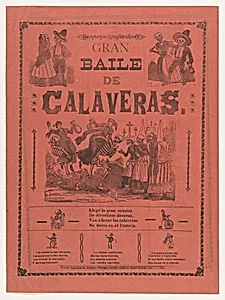
The great dance of skeletons
Medium
Type-metal engraving and letterpress on orange paper
Dimensions
Sheet: 15 3/4 × 11 5/8 in. (40 × 29.5 cm)
Classification
Prints
Department
Drawings and Prints
Museum
Metropolitan Museum of Art, New York, NY
Credit
The Elisha Whittelsey Collection, The Elisha Whittelsey Fund, 1946
Accession Number
46.46.287
Rights
Public Domain
Tags
Art Historical Context
Behold *The Great Dance of Stons* (1906), a striking type-metal engraving and letterpress print on vibrant orange paper by the legendary Mexican artist José Guadalupeada, in collaboration with publisher Antonio Vanegas Arroyo. 15 3/4 × 11 5/8 inches, this work from the Metropolitan Museum of Art's Drawings and Prints department captures a macabre yet lively scene of skeletons engaged in a joyous dance. Posada's iconic calavera (skeleton) figures, often satirical, whirl with human-like energy, blurring the lines between the living and the dead. Created during Mexico's Porfiriato era under President Porfirio Díaz, the print exemplifies Posada's mastery of affordable relief printing techniques, used for popular broadsheets (corridos ilustrados) that reached everyday audiences. These methods allowed for bold, high-contrast images paired with text, making art accessible beyond elite circles. The dancing skeletons satirize societal vanities—wealth, power, and class distinctions—reminding viewers of death's impartiality, a theme rooted in Mexican Day of the Dead traditions. Posada's influence endures in Mexican graphic arts and beyond, inspiring modernists like Diego Rivera. This piece, part of The Elisha Whittelsey Collection, highlights how satire and folk imagery critiqued inequality, offering timeless commentary on the human condition through whimsical, skeletal revelry.
About the Artist
José Guadalupe Posada|Antonio Vanegas Arroyo · 1852–1913
José Guadalupe Posada (1852-1913) was a Mexican printmaker and engraver who revolutionized popular art and created some of the most iconic images in Mexican culture. Working primarily with publisher Antonio Vanegas Arroyo, he produced over 20,000 images during his career—inexpensive broadsheets sold for a penny on colored paper that made his art accessible to even the poorest workers. He transform...