
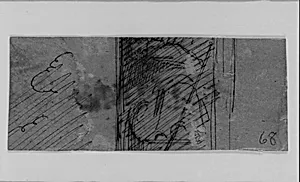
The Guard Tents (Recto) (from Sketchbook)
ca. 1854
Medium
Black ink on brown wove paper
Dimensions
1 1/16 x 2 11/16 in. (2.7 x 6.8 cm)
Classification
Drawing
Culture
American
Department
The American Wing
Museum
Metropolitan Museum of Art, New York, NY
Credit
Gift of Margaret C. Buell, Helen L. King, and Sybil A. Walk, 1970
Accession Number
1970.121.68
Rights
Public Domain
Art Historical Context
Nestled in the American Wing of the Metropolitan Museum Art, *The Guard Tents (Recto)* from James McNeill Whist sketchbook (ca. 1854) offers a glimpse into the young artist's keen eye for everyday scenes. Rendered in black ink on wove paper, thisutive work—measuring just 1 1/16 x 2 11/16 inches—captures the simple forms of guard tents, likely during Whistler's formative years in the United States. As the recto side of abook page, it exemplifies the spontaneous, portable nature of such studies, perfect for an artist on the move. Whistler, born in 1834, was in his early twenties when he created this, shortly before departing for Europe and embracing his signature Aestheticism and tonal harmonies. This early piece reflects his American roots and initial training at West Point, where military life may have inspired the subject. Sketchbook drawings like this were crucial for honing observation skills, bridging Realism's precise lines with Whistler's later impressionistic flair. The choice of brown wove paper adds warmth and texture, enhancing the ink's fluid strokes and evoking the earthy tones of camp life. Donated in 1970, this intimate artifact reminds us how Whistler's genius began with humble, handheld sketches—windows into a career that redefined modern art.
About the Artist
James McNeill Whistler · 1834–1903
James Abbott McNeill Whistler (1834-1903) was an American-born painter and printmaker who became a leading figure in the Aesthetic Movement and pioneer of Tonalism and Japonisme. He revolutionized art by championing "art for art's sake" and treating paintings as visual equivalents of musical compositions, titling works as "arrangements," "harmonies," and "nocturnes" to emphasize formal qualities o...