
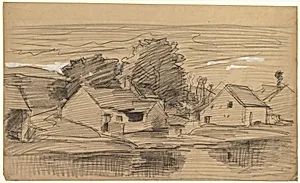
The Hamlet of Optevoz
ca. 1852
Medium
Charcoal and lead white
Dimensions
14 7/8 x 24 3/4 in. (37.8 x 62.8cm)
Classification
Drawings
Department
Drawings and Prints
Museum
Metropolitan Museum of Art, New York, NY
Credit
Rogers Fund, 1912
Accession Number
12.100
Rights
Public Domain
Tags
Art Historical Context
Charles-François Daubigny’s *The Hamlet of Opte* (ca. 1852) captures the serene charm of a rural French village, with clusters of houses nestled among lush trees. As a leading figure in the Barbizon school, Daubigny was renowned for his landscapes that celebrated the unadorned beauty of the countryside, drawing inspiration from the forests and villages near Paris. This drawing reflects the mid-19th-century toward plein air sketching, where artists like Daubigny ventured outdoors to study nature directly, paving the way for Impressionism. Rendered in charcoal and lead white on paper, the work showcases Daubigny’s masterful use of mixed media. Charcoal lends rich, velvety tones and textured depth to the foliage and architecture, while touches of lead white create glowing highlights that evoke dappled sunlight filtering through branches. At 14 7/8 x 24 3/4 inches, its horizontal format emphasizes the expansive, harmonious village scene, blending human habitation with nature in a poetic balance. Acquired through the Rogers Fund in 1912, this drawing from the Metropolitan Museum of Art’s Department of Drawings and Prints offers a glimpse into Daubigny’s preparatory process, highlighting his innovative techniques for conveying atmosphere and light in an intimate, monochromatic study.
About the Artist
Charles-François Daubigny · 1817–1878
Charles-François Daubigny was born on February 15, 1817, in Paris into a family of artists, with his father, Edmé-François Daubigny, a classical landscape painter, and his uncle, Pierre Daubigny, a miniaturist, providing his initial artistic training. He further studied under Jean-Victor Bertin, Jacques Raymond Brascassat, and Paul Delaroche at the École des Beaux-Arts, though he quickly moved bey...