
The Hamlet on Mountainous Ground
mid-17th century
Medium
Etching; fourth state of four
Dimensions
plate: 4 1/8 x 4 5/16 in. (10.5 x 11 cm) sheet: 5 11/16 x 6 1/16 in. (14.4 x 15.4 cm)
Classification
Prints
Department
Drawings and Prints
Museum
Metropolitan Museum of Art, New York, NY
Credit
Gift of Mary G. Seiler, 2009
Accession Number
2009.302.4
Rights
Public Domain
Tags
Art Historical Context
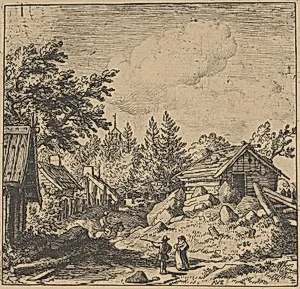
Allart van Everdingen's *The Hamlet on Mountainous*, an etching from the mid-17th, captures the rugged charm of a remote Nordic village perched amid dramatic peaks. Created during the Dutch Golden Age, this intimate print (plate: 4 1/8 x 4 5/16 in.) reflectsdingen's fascination with Scandinavian landscapes, drawn from his travels to Sweden and Norway in the 1640s. As a pioneer in introducing northern scenery to Dutch art, he blended these wild vistas with the refined traditions of his homeland, evoking a sense of untamed wilderness. The fourth state of four, this etching showcases meticulous line work typical of the medium, where acid bites into a metal plate to create rich, tonal depths. Tiny houses cluster on steep slopes, while hunters and human figures animate the scene, hinting at daily life amid nature's grandeur. Everdingen's precise technique allows for intricate details in such a small format, making it a gem for close contemplation. Housed in the Metropolitan Museum of Art's Drawings and Prints department (gift of Mary G. Seiler, 2009), this work exemplifies 17th-century printmaking's role in democratizing art, letting collectors own evocative landscapes without the scale of paintings. It's a window into how Dutch artists romanticized the exotic "North," influencing generations of landscape etchers.
About the Artist
Allart van Everdingen · 1621–1675
Allaert van Everdingen (1621-1675) was a Dutch Golden Age painter and printmaker who introduced Scandinavian landscape painting to the Netherlands. Born in Alkmaar and baptized on June 18, 1621, he pioneered a distinctive genre of Nordic mountain scenery that profoundly influenced Dutch landscape painting and later inspired the Romantic movement. Van Everdingen holds a unique place in art history...