
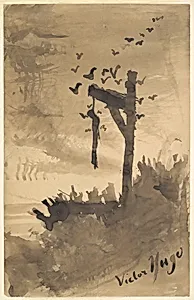
The Hanged Man
ca. 1855–60
Medium
Brush and ink wash on wove paper
Dimensions
sheet: 12 x 7 11/16 in. (30.5 x 19.5 cm)
Classification
Drawings
Department
Drawings and Prints
Museum
Metropolitan Museum of Art, New York, NY
Credit
Gift of Kristina and Guy Wildenstein, 2003
Accession Number
2003.144
Rights
Public Domain
Tags
Art Historical Context
Victor Hugo, the renowned French Romantic author of *Les Misérables* andThe Hunchback of Notre-Dame*, was a prolific and experimental draftsman. Created around 1855–60 his political exile on the Channel Island of Guernsey, *The Hanged Man* his private, visionary drawing practice. Working in brush and ink wash onove paper—a smooth, versatile support ideal for fluid tonal effects—Hugo produced hundreds of such works, often spontaneously, blending poetry, spirituality, and the macabre. This haunting drawing, measuring 12 x 7 11/16 inches, evokes themes of death and transformation, as suggested by its title and tags of birds, men, and mortality. The hanged figure, suspended in an ethereal void, recalls Tarot symbolism of surrender and enlightenment, while birds may symbolize the soul's flight or omens of fate. Hugo's ink wash technique, involving diluted ink brushed in layers, creates misty atmospheres and ghostly forms, pushing beyond conventional representation toward the surreal and subconscious. Housed in the Metropolitan Museum of Art's Drawings and Prints department (gift of Kristina and Guy Wildenstein, 2003), *The Hanged Man* highlights Hugo's dual legacy as literary giant and artistic innovator. These intimate works, rarely exhibited in his lifetime, reveal a restless imagination grappling with exile, loss, and the supernatural, offering visitors a glimpse into 19th-century Romanticism's shadowy depths.
About the Artist
Victor Hugo · 1802–1885
In addition to his literary output, Hugo produced a large number of visual works on paper. These constitute a mass of drawings in various media, comprising views of landscapes and buildings drawn from life or wholly imagined. He employed experimental techniques, using stencils, and impressions of fabric or other objects. He often reworked inkblots or stains into fantastic landscapes or figures, t...