
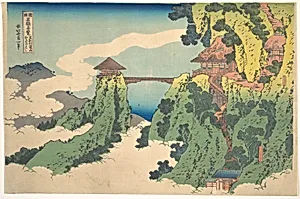
諸國名橋奇覧 足利行道山くものかけはし|The Hanging-cloud Bridge at Mount Gyōdō near Ashikaga (Ashikaga Gyōdōzan kumo no kakehashi), from the series Remarkable Views of Bridges in Various Provinces (Shokoku meikyō kiran)
1760–1849
Medium
Woodblock print; ink and color on paper
Dimensions
H. 10 1/8 in. (25.7 cm); W. 15 1/8 in. (38.4 cm)
Classification
Prints
Culture & Period
Japan · Edo period (1615–1868)
Department
Asian Art
Museum
Metropolitan Museum of Art, New York, NY
Credit
Henry L. Phillips Collection, Bequest of Henry L. Phillips, 1939
Accession Number
JP2942
Rights
Public Domain
Tags
About this artwork
The Hanging-cloud Bridge at Mount Gyōdō near Ashikaga is a woodblock print by Katsushika Hokusai from the series Remarkable Views of Bridges in Various Provinces (Shokoku meikyō kiran), created during the artist's mature period. The print exemplifies Hokusai's fascination with engineering marvels and dramatic perspectives. The composition presents a vertiginous view of a precarious rope bridge spanning a deep ravine at Mount Gyōdō. Small figures traverse the suspended walkway, emphasizing the d...
Art Historical Context
Katsushika Hokusai, the legendary Japanese artist of the Edo period (1615–1868), captured the daring ingenuity of Japan's engineering feats in his series *Remarkable Views of Bridges in Various Provinces* (*Shokoku meikyō kiran*), produced around 1833–1834. This woodblock print, *The Hanging-cloud Bridge at Mount Gyōdō near Ashikaga*, showcases one of approximately eleven known designs from this rare series, created during Hokusai's highly productive mature phase—coinciding with his iconic *Thirty-six Views of Mount Fuji*. As a master of ukiyo-e ("pictures of the floating world"), Hokusai blended traditional Japanese composition with emerging Western perspective techniques, highlighting dramatic landscapes and human endeavor. The print offers a breathtaking, vertiginous vista of a swaying rope bridge suspended over a misty ravine at Mount Gyōdō, its name evoking the clouds enveloping the structure. Tiny figures inch across the precarious span amid steep cliffs, jagged rocks, houses, and trees, emphasizing the colossal scale and peril. Hokusai's nishiki-e (brocade picture) technique—using multiple carved woodblocks for layered ink and color on paper—brings vivid depth through bold outlines, subtle gradations, and geometric contrasts against organic forms. This work not only celebrates Japan's provincial marvels but also influenced later printmakers and European artists after Japan opened to the West, bridging Eastern and Western artistic traditions. At 10⅛ × 15⅛ inches, it's a compact window into Hokusai's boundless curiosity.
About the Artist
Katsushika Hokusai · 1760–1849
Katsushika Hokusai (1760-1849) stands as one of history's most influential artists, a Japanese master who revolutionized the ukiyo-e woodblock print tradition and profoundly shaped Western art. Born in the Katsushika district of Edo (modern-day Tokyo) to an artisan family, Hokusai lived through nearly nine decades of extraordinary creative evolution, adopting over thirty different artistic names t...