
The Harp Player (A Solo)
1888
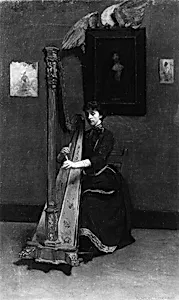
Medium
Oil on canvas
Dimensions
30 x 17 7/8 in. (76.2 x 45.4 cm)
Classification
Painting
Culture
American
Department
The American Wing
Museum
Metropolitan Museum of Art, New York, NY
Credit
Rogers Fund, 1912
Accession Number
12.40
Rights
Public Domain
Tags
Art Historical Context
Kenyon Cox's *The Harp Player (A Solo)* painted in 1888, a poised female musician immersed in her performance on a grand harp. This oil on canvas, measuring 30 x 17 7/8 inches, exemplifies the artist's early mastery of the human form, rendered with elegant lines and soft, luminous brushwork that evokes classical harmony. Housed in The Metropolitan Museum of Art's American Wing since its acquisition via the Rogers Fund in 1912, the work reflects late 19th-century American fascination with music as a symbol of refinement and femininity during the Gilded Age. Cox, a prominent figure in American academic art, drew from his European training in Paris under masters like Carolus-Duran and Gérôme, blending neoclassical ideals with a modern sensibility. His style emphasized idealized beauty and mythological undertones, here transformed into an intimate genre scene of a solo harpist—evoking the muses of ancient Greece while celebrating contemporary women's artistic pursuits. Harps, often associated with celestial grace, add a layer of cultural poetry, highlighting music's elevating power in Victorian-era society. As a quintessential example of American oil painting, this piece showcases the medium's versatility for achieving rich textures and depth, from the harp's gleaming strings to the subtle folds of the musician's gown. Visitors will appreciate its serene composure, inviting reflection on art's timeless role in harmonizing beauty and emotion.
About the Artist
Kenyon Cox · 1856–1919
Kenyon Cox (1856–1919) was born on October 27 in Warren, Ohio, to General Jacob Dolson Cox, a prominent politician and Civil War veteran, and Helen Finney Cox. Despite fragile health, young Cox pursued art at the Art Academy of Cincinnati before advancing to the Pennsylvania Academy of the Fine Arts in Philadelphia. In 1877, he traveled to Paris, studying first under Carolus-Duran, then at the Éco...