
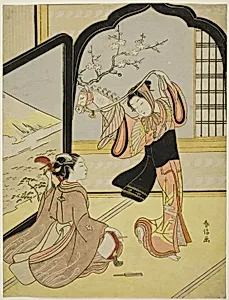
The Harugoma Dance
c. 1767/68
Medium
Color woodblock print; chuban
Dimensions
27 × 20.4 cm (10 5/8 × 8 in.)
Classification
woodblock print
Department
Arts of Asia
Museum
Art Institute of Chicago
Accession Number
61394
Rights
Public Domain
Art Historical Context
Suzuki Harunobu's *The Harugoma* (c. 1767/68) captures a vibrant moment from Japan's Edo-period floating world, rendered in a delicate color woodblock print on chuban paper—a popular medium format measuring 27 × 20.4 cm. As one of the earliest masters of *nishiki-e* (brocade pictures), Harunobu pioneered full-color printing techniques around 1765, transforming ukiyo-e art from monochrome to lush, multicolored scenes of everyday life, theater, and festivals. This print exemplifies his signature style: graceful figures with soft, rounded forms and subtle gradations achieved through meticulous carving and multiple woodblocks. The Harugoma Dance likely depicts performers in a lively traditional routine, possibly evoking spring festivals or lion dances (*shishimai*), which were beloved entertainments in 18th-century urban Japan. Harunobu's work democratized art, making sophisticated imagery affordable to merchants and commoners via mass-produced prints sold in Edo (modern Tokyo). Housed in the Art Institute of Chicago's Arts of Asia department, this piece highlights ukiyo-e's cultural role in preserving fleeting pleasures amid Japan's rigid social hierarchy. Its technical brilliance lies in the precise registration of colors—vermilion reds, indigos, and golds—creating a sense of movement and joy. A gem for visitors, it invites us to step into Harunobu's whimsical world, where dance bridges the ephemeral and eternal.
About the Artist
Suzuki Harunobu · 1725–1770
Suzuki Harunobu (c. 1725-1770) was a Japanese ukiyo-e artist who revolutionized woodblock printing by developing nishiki-e—full-color prints using multiple woodblocks—in 1765. Before Harunobu, Japanese prints were limited to two or three colors; his innovation unleashed the entire artist's palette, transforming ukiyo-e into the vibrant art form that would later captivate Western artists from Manet...