
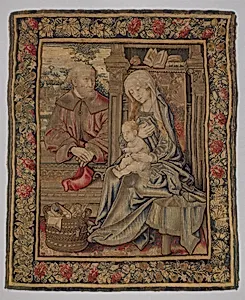
The Holy Family
Unknown Artist
ca. 1500
Medium
Wool, silk, and gilt- and silvered-metal-strip-wrapped silk in slit, dovetailed, and interlocking tapestry weave with supplementary brocading wefts (in sewing basket, Joseph's coat, and hem of Mary's cloak)
Dimensions
40 9/16 x 46 15/16 in. (103.1 x 119.2 cm)
Classification
Textiles-Tapestries
Culture
Flemish, Southern Netherlands
Department
Robert Lehman Collection
Museum
Metropolitan Museum of Art, New York, NY
Credit
Robert Lehman Collection, 1975
Accession Number
1975.1.1913
Rights
Public Domain
Tags
Art Historical Context
### The Holy Family Created around 1500 in the Southern Netherlands, this exquisite Flemish tapestry depicts the Holy Family—Virgin Mary, the infant Jesus, and Saint—in a tender, intimate scene. During the late Middle Ages and early Renaissance, such religious imagery was central to devotional life, adorning churches, homes, and palaces as symbols of faith and protection. Produced in the renowned weaving centers like Brussels or Tournai, tapestries like this one were prestige objects, rivaling paintings in their narrative power and opulence. The artwork's technical mastery shines in its slit, dovetailed, and interlocking tapestry weave, using wool and silk for rich colors and durability. Supplementary brocading wefts—gilt- and silvered-metal-strip-wrapped silk—add luxurious metallic highlights to details like Joseph's coat, the hem of Mary's cloak, and a sewing basket, creating a shimmering, three-dimensional effect that catches the light. Measuring about 40 by 47 inches, it exemplifies the era's innovative textile artistry, where weavers achieved painterly precision without brushes. Housed in the Metropolitan Museum of Art's Robert Lehman Collection since 1975, this anonymous masterpiece reflects Flemish tapestries' cultural pinnacle: blending spirituality with craftsmanship to inspire awe and contemplation. Visitors can imagine it hanging in a dimly lit chapel, glowing under candlelight.