
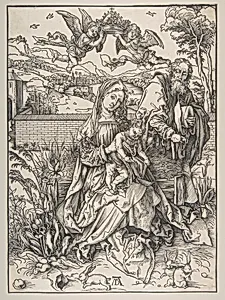
The Holy Family with Three Hares
ca. 1497–98
Medium
Woodcut, first state of nine
Dimensions
image: 15 1/8 x 11 in. (38.4 x 27.9 cm) trimmed to block line
Classification
Prints
Department
Drawings and Prints
Museum
Metropolitan Museum of Art, New York, NY
Credit
Gift of Junius Spencer Morgan, 1919
Accession Number
19.73.168
Rights
Public Domain
Tags
Art Historical Context
Albrecht Dürer’s *The Holy Family with Three Hares*, created around 1497–98, captures the tender intimacy of Mary, Joseph, and the Christ Child surrounded by angels. As one of the most influential artists of the Northern Renaissance, Dürer elevated the woodcut from a simple reproductive medium into a sophisticated art form capable of extraordinary detail and expressive power. This early impression, the first of nine states, reveals the crisp lines and subtle modeling that made his prints highly sought after across Europe. Printed on a sheet measuring roughly 15 by 11 inches, the woodcut demonstrates Dürer’s technical mastery in carving intricate textures—from the soft folds of drapery to the delicate wings of angels. Woodcuts like this one played a vital role in the late fifteenth century by allowing religious imagery to reach wide audiences beyond the walls of churches and palaces. The presence of three hares adds a playful, symbolic note to the sacred scene, inviting viewers to reflect on themes of fertility and divine care. Housed in the Metropolitan Museum of Art’s collection of prints, this work remains a testament to Dürer’s ability to blend devotional subject matter with inventive storytelling.
About the Artist
Albrecht Dürer · 1471–1528
Albrecht Dürer (1471–1528) stands as the preeminent figure of the Northern Renaissance and arguably the most influential artist in the history of printmaking. Born in Nuremberg on May 21, 1471, and dying in the same city on April 6, 1528, Dürer revolutionized the status of the artist in Northern Europe, transforming printmaking from a commercial craft into an independent fine art and establishing ...