
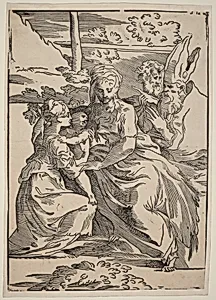
The Holy Family with Two Saints
1501 to 1550
Medium
chiaroscuro woodcut printed in black from line block only [proof]
Dimensions
sheet (trimmed to and within border): 31 x 21.7 cm (12 3/16 x 8 9/16 in.) support: 32.3 x 22.5 cm (12 11/16 x 8 7/8 in.)
Classification
Department
CG-E
Museum
National Gallery of Art, Washington, D.C.
Credit
Ailsa Mellon Bruce Fund
Accession Number
1988.65.2
Rights
Public Domain
Art Historical Context
Behold *The Holy Family with Two*, a captivating chiaroscuro woodcut by Antonio da Trento, faithfully reproducing a design by the Mannerist master Parmigianino (Francesco Mazz, 1503–1540). Created between 1501 and 1550 during the Italian Renaissance, this print depicts the tender scene of the Virgin Mary, Christ Child, and St. Joseph accompanied by two saints, embodying the era's devotional art that brought sacred figures into intimate, human scale for worshippers. The medium is a chiaroscuro woodcut—a revolutionary 16th-century technique using multiple blocks to mimic the light-and-shadow drama of oil paintings. This rare proof, printed solely in black from the line block, reveals the foundational design stage before color tones were added, offering a glimpse into the printmaker's meticulous process. Trimmed to 31 x 21.7 cm, its crisp lines showcase Parmigianino's elegant, elongated figures and graceful poses, hallmarks of Mannerism's refined stylization. Housed in the National Gallery of Art's Prints department (acquired via the Ailsa Mellon Bruce Fund), this work highlights the fruitful collaboration between innovative painters and printmakers like da Trento, who helped democratize high art through affordable reproductions. A testament to Renaissance ingenuity, it invites you to appreciate how prints bridged the gap between elite canvases and everyday devotion.