
The Holy Kinship
c. 1495
Medium
oil on panel
Dimensions
105.8; 137.2
Rights
Public Domain
About this artwork
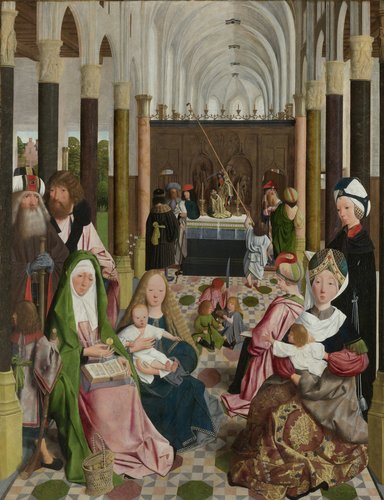
Kerkinterieur met de heilige maagschap, allen verwanten van Christus. Links de heilige Anna, naast haar Maria met het Christuskind. Achter hen staan Joachim en Jozef. Rechts Elisabeth met Johannes de Doper als kind, hierbij ook Maria Salome en Maria Cleophas. Bij het altaar staan Alpheüs, Zebedeüs en Zacharias. Voor het altaar spelen de discipelen, nog als kinderen, Simon, Jacobus en Johannes. Voor het altaar steekt Judas Thaddeüs een kaars op de koorafsluiting aan. Op het altaar staat een beeld...
Art Historical Context
### The Holy Kinship by Geertgen tot Sint Step into the serene glow of a late medieval church interior in Geertgen tot Sint Jans *The Holy Kinship (c. 1495), a masterful oil-on-panel painting from the early Northern Renaissance. Hailing from Haarlem, Geertgen was a pioneer in capturing intimate, luminous religious scenes with remarkable detail and realism, blending Flemish influences like those of Jan van Eyck with emerging Dutch naturalism. This large work (137.2 × 105.8 cm) depicts the extended family of Christ—known as the Holy Kinship—gathered in devotion, emphasizing themes of lineage, piety, and divine connection central to late 15th-century devotion. On the left, Saint Anne stands beside the Virgin Mary cradling the Christ Child, with Joachim and Joseph behind them. To the right, Elizabeth holds the young John the Baptist, joined by Mary Salome and Mary Cleophas. Near the altar are Alpheüs, Zebedeüs, and Zacharias, while child disciples—Simon, James, and John—play innocently before it. Judas Thaddeüs lights a candle on the choir screen, and atop the altar sits a poignant sculpture of Abraham's sacrifice, symbolizing faith and obedience. Geertgen's oil technique allows for translucent glazes that bathe the scene in ethereal light, heightening the spiritual intimacy and architectural depth. Housed in Amsterdam's Rijksmuseum, this painting reflects the era's fascination with expanded biblical narratives, offering worshippers a visual meditation on sacred bonds. Its vivid portrayal of holy figures as relatable kin made it a cherished altarpiece, inviting viewers then and now to ponder family, faith, and the everyday divine.
About the Artist
Geertgen tot Sint Jans · 1455–1495
His only documented work is a triptych for the monastery church of the Brethren of St John, of which he was a lay-brother (two panels survive). About 15 other paintings are attributed to him. He was known for his charming figures, melancholy mood and sensitivity to light. Comment on works: Religious