
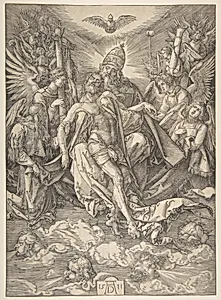
The Holy Trinity
n.d.
Medium
Woodcut
Dimensions
sheet: 15 3/16 x 11 in. (38.6 x 27.9 cm)
Classification
Prints
Department
Drawings and Prints
Museum
Metropolitan Museum of Art, New York, NY
Credit
Harris Brisbane Dick Fund, 1930
Accession Number
30.55.4
Rights
Public Domain
Tags
Art Historical Context
Albrecht Dürer's *The Holy Trinity* is masterful woodcut exemplifying the Northern Renaissance artist's revolutionary approach to printmaking. Created on a large sheet measuring 15 3/16 x 11 inches, this undated work depicts the Christian doctrine of the Trinity: God the Father supporting the crucified Christ on the cross, with the Holy Spirit as a dove above, surrounded by adoring angels and symbolic birds. Dürer's intricate carving technique transforms the humble woodblock medium into a vehicle for profound religious devotion, achieving remarkable detail and tonal depth through expert relief printing. As a pioneer of the woodcut, Dürer elevated prints from mere reproductions to collectible artworks, making complex theological imagery accessible to a wide audience during the early 16th century. This piece reflects the era's intense religious fervor amid the Protestant Reformation, where visual piety played a key role in personal faith. Housed in the Metropolitan Museum of Art's Drawings and Prints department, acquired via the Harris Brisbane Dick Fund in 1930, it showcases Dürer's fusion of German precision with Italian Renaissance humanism. Visitors will appreciate how *The Holy Trinity* captures divine harmony in bold contrasts and dynamic composition, inviting contemplation of eternity through its soaring angels and central cross—a testament to Dürer's enduring legacy in bridging art and spirituality.
About the Artist
Albrecht Dürer · 1471–1528
Albrecht Dürer (1471–1528) stands as the preeminent figure of the Northern Renaissance and arguably the most influential artist in the history of printmaking. Born in Nuremberg on May 21, 1471, and dying in the same city on April 6, 1528, Dürer revolutionized the status of the artist in Northern Europe, transforming printmaking from a commercial craft into an independent fine art and establishing ...