
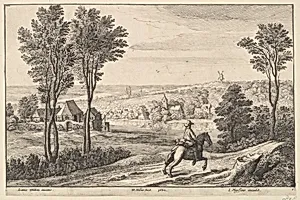
The Horseman
Medium
Etching; second state of four
Dimensions
Plate: 5 9/16 × 8 1/2 in. (14.2 × 21.6 cm)
Classification
Prints
Department
Drawings and Prints
Museum
Metropolitan Museum of Art, New York, NY
Credit
The Elisha Whittelsey Collection, The Elisha Whittelsey Fund, 1951
Accession Number
51.501.1405
Rights
Public Domain
Tags
Art Historical Context
Behold *The Horseman* (1650), a etching by the masterful Bohemian printmaker Wenceslaus Hollar after a design by Flemish landscape artist Jan Wildens. This second state of four captures a serene 17th-century European vista, featuring a lone rider on horseback amid rolling landscapes, sturdy houses, and leafy trees. Measuring just 5 9/16 × 8 1/2 inches, its intimate scale invites close inspection, revealing Hollar's extraordinary precision in rendering textures—from the horse's flowing mane to the intricate foliage. Hollar, renowned for his topographic views and meticulous detail during the Baroque era, collaborated here with Wildens, a specialist in atmospheric landscapes often linked to Peter Paul Rubens' circle. Etching allowed Hollar to translate Wildens' painterly vision into reproducible prints, a revolutionary technique using acid-etched copper plates for fine, expressive lines. The progressive states reflect the artist's refinements, adding depth and nuance. Housed in the Metropolitan Museum of Art's Elisha Whittelsey Collection, this work exemplifies the golden age of printmaking, bridging painting and graphic arts. It offers a window into everyday 17th-century life, blending human presence with nature's grandeur—a timeless testament to collaborative artistry. (198 words)
About the Artist
Wenceslaus Hollar|Jan Wildens · 1607–1677
Wenceslaus Hollar (1607-1677) was a prolific Bohemian etcher who became one of the most accomplished printmakers of the seventeenth century. Born in Prague, he trained under Matthäus Merian in Frankfurt before entering the service of Thomas Howard, Earl of Arundel, in 1636. Hollar spent most of his career in England, where he produced approximately 2,740 etchings documenting an extraordinary range...