
The Hours of Jeanne d'Evreux, Queen of France
ca. 1324–28
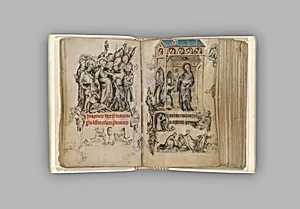
Medium
Grisaille, tempera, and ink on vellum
Dimensions
single folio: 3 5/8 x 2 7/16 in. (9.2 x 6.2 cm) Overall (with binding): 3 7/8 x 2 13/16 x 1 1/2 in. (9.9 x 7.2 x 3.8 cm)
Classification
Manuscripts and Illuminations
Culture
French
Department
The Cloisters
Museum
Metropolitan Museum of Art, New York, NY
Credit
The Cloisters Collection, 1954
Accession Number
54.1.2
Rights
Public Domain
Tags
About this artwork
This illuminated manuscript represents one of the masterpieces of Gothic art, created by Jean Pucelle for Jeanne d'Evreux, Queen of France, between 1324 and 1328. The book of hours contains 209 vellum folios with twenty-five full-page paintings pairing scenes from the Infancy and Passion of Christ with episodes from the life of Saint Louis. The miniatures are rendered in delicate grisaille, giving the figures an amazingly sculptural quality, accented with rich colors including touches of lilac a...
Art Historical Context
open folio from *The Hours of Jeanne d’Evreux* displays two delicately painted pages on vellum. The left page shows a dense gathering of robed figures in varying poses, rendered in fine gray tones with red Latin text below. The right page presents a standing female figure beneath a small architectural canopy with a blue roof, approached by a winged angel, while smaller marginal scenes and creatures—rabbits, dogs, and fantastical beings—fill the borders in the same restrained palette. Jean Pucelle created this book of hours in Paris around 1324–28 for Queen Jeanne d’Evreux using grisaille, tempera, and ink. The technique gives the figures a sculptural quality through subtle modeling, accented by touches of color. Its twenty-five full-page miniatures pair episodes from the life of Christ with scenes from the life of Saint Louis, surrounded by nearly seven hundred marginal illustrations of medieval street life and fantasy. Measuring just over three and a half inches tall, the manuscript demonstrates extraordinary refinement. Pucelle’s elegant line and innovative blend of northern and Italian influences mark it as a high point of Gothic illumination at the French court.