
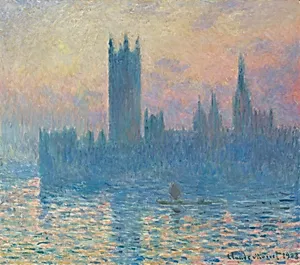
The Houses of Parliament, Sunset
1903
Medium
oil on canvas
Dimensions
overall: 81.3 x 92.5 cm (32 x 36 7/16 in.) framed: 107 x 117.5 x 8.8 cm (42 1/8 x 46 1/4 x 3 7/16 in.)
Classification
Painting
Department
CF
Museum
National Gallery of Art, Washington, D.C.
Credit
Chester Dale Collection
Accession Number
1963.10.48
Rights
Public Domain
Art Historical Context
Claude Monet’s *The Houses of Parliament, Sunset* (1903) captures the Gothic silhouette of London’s iconic riverside buildings bathed in the warm, dissolving light of dusk. Painted from a vantage point across the Thames, the work belongs to the artist’s celebrated London series, created during several visits between 1899 and 1901 and completed in his studio at Giverny. Rather than merely recording architecture, Monet used the subject to explore the transient effects of atmosphere and color. As a leading figure of Impressionism, Monet worked in oil on canvas to layer delicate veils of pigment that suggest mist, smoke, and reflected sunlight rather than precise architectural detail. The glowing oranges and purples of the sunset contrast with cooler blues and greens in the water, demonstrating his lifelong fascination with how light transforms familiar scenes from moment to moment. This painting, now part of the National Gallery of Art’s Chester Dale Collection, exemplifies Monet’s late-career focus on serial imagery. By returning repeatedly to the same motif under varying conditions, he invited viewers to experience the quiet poetry of changing light and the subtle beauty of an urban landscape at day’s end.
About the Artist
Claude Monet · 1840–1926
Claude Monet, born Oscar-Claude Monet on November 14, 1840, in Paris and raised in Le Havre, Normandy, began his artistic journey as a successful teenage caricaturist. His formal training started at the Le Havre secondary school of the arts in 1851, where he received his first drawing lessons from Jacques-François Ochard. Around 1858, he met Eugène Boudin, who became his pivotal mentor, introducin...