
The Hurdy-Gurdy Boy
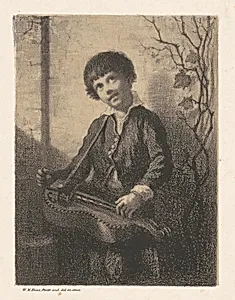
Medium
lithograph in black with tan stone tint on wove paper
Dimensions
image: 19.05 × 14.61 cm (7 1/2 × 5 3/4 in.) sheet: 38.1 × 30.32 cm (15 × 11 15/16 in.)
Classification
Department
CG-W
Museum
National Gallery of Art, Washington, D.C.
Credit
Corcoran Collection (Gift of Alice F. Williams)
Accession Number
2015.19.915
Rights
Public Domain
Art Historical Context
William Morris Hunt’s *The Hurdy-Gurdy Boy* (1857) captures a charming moment of everyday street life through the delicate medium of lithography. Printed in black with a warm tan stone tint on w paper, the work showcases Hunt’s ability to convey texture and mood with subtle tonal gradations. The young musician, centered in the composition, holds his hurdy-gurdy—an instrument traditionally associated with itinerant performers—inviting viewers to pause and consider the fleeting presence of such figures in mid-nineteenth-century Europe and America. As a print, this lithograph reflects the growing popularity of affordable reproductive techniques that allowed artists to reach wider audiences beyond the elite circles of painting collectors. Hunt, who trained in France and absorbed the Barbizon interest in humble subjects, brings a sympathetic eye to his portrayal of the boy. The modest scale and soft coloring lend an intimate, almost nostalgic quality to the scene. Today the impression resides in the National Gallery of Art’s Corcoran Collection, preserving a quiet testament to Hunt’s early exploration of genre imagery and the democratic spirit of printmaking in the 1850s.
About the Artist
William Morris Hunt · 1824–1879
American, Brattleboro, Vermont 1824–1879 Appledore, New Hampshire