
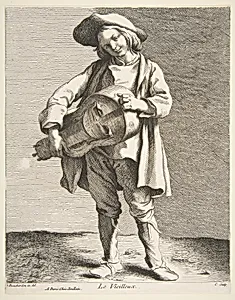
The Hurdy-Gurdy Player
Medium
Etching with some engraving
Dimensions
image: 9 1/16 x 7 3/8 in. (23 x 18.8 cm) sheet: 9 7/16 x 7 1/2 in. (24 x 19 cm)
Classification
Prints
Department
Drawings and Prints
Museum
Metropolitan Museum of Art, New York, NY
Credit
Harris Brisbane Dick Fund, 1953
Accession Number
53.600.588(8)
Rights
Public Domain
Tags
Art Historical Context
Behold *The Hurdy-Gurdy Player* (1737), a captivating etching with some engraving by the collaborative of Anne Claude Philippe de Tubières, de Caylus—an influential French antiquarian and engraver—and Edme Bouch, a leading sculptor and printmaker. Measuring just over 9 by 7 inches, this intimate print depicts a female musician immersed in playing the hurdyurdy, a quirky medieval-era instrument that uses a hand-cranked rosined wheel to vibrate strings, evoking rustic folk melodies. The mixed technique of etching (for fluid, spontaneous lines) and engraving (for precise, crisp details) highlights the artists' skill in translating texture and movement onto paper, a hallmark of 18th-century French printmaking. Bouchardon’s anatomical finesse and Caylus’s scholarly eye capture the player’s focused expression and the instrument’s intricate mechanics with remarkable clarity. Housed in the Metropolitan Museum of Art’s Drawings and Prints department (thanks to the Harris Brisbane Dick Fund, 1953), this work offers a window into Enlightenment-era fascination with everyday musicians and women in the arts. It celebrates the hurdy-gurdy’s enduring cultural role, from street performers to courtly entertainments, blending technical virtuosity with charming human portraiture.