
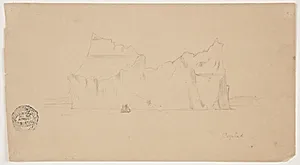
The Iceberg, Canada
Classification
seascapes
Department
Smithsonian Collection
Museum
Smithsonian American Art Museum
Credit
Gift of Louis P. Church
Accession Number
1917-4-275-a
Rights
Public Domain
About this artwork
Research in Progress
Art Historical Context
Frederic Edwin Church a leading figure of the Hudson River School, *The Iceberg, Canada* in 1859, capturing the raw majesty of North American wilderness. This seascape reflects the Romantic era's fascination with nature's sublime power, where artists like Church portrayed dramatic landscapes to evoke awe and spiritual reflection. Church, who studied under Thomas Cole, traveled extensively to sketch real scenes, infusing his works with meticulous detail drawn from firsthand observation—likely inspired by expeditions to Canada's icy coasts during a time of growing American interest in polar exploration. As a quintessential Hudson River School piece, *The Iceberg* exemplifies luminism, a style emphasizing radiant light effects and atmospheric clarity to heighten emotional impact. Though the medium is unknown, Church's oils typically featured luminous skies and crystalline forms, symbolizing both beauty and peril amid 19th-century expansionism. Housed in the Smithsonian American Art Museum as a gift from Louis P. Church, it invites viewers to ponder humanity's fragile place in the vast, untamed world. This work underscores Church's role in elevating American landscape painting to national symbolism, bridging art and science in an age of discovery. (198 words)