
The Iliad and the Odyssey
Medium
Illustrations: line engraving
Dimensions
8 3/4 x 5 11/16 x 1 5/16 in. (22.2 x 14.4 x 3.3 cm)
Classification
Books
Department
Drawings and Prints
Museum
Metropolitan Museum of Art, New York, NY
Credit
Bequest of W. Gedney Beatty, 1941
Accession Number
41.100.567(1)
Rights
Public Domain
Tags
Art Historical Context
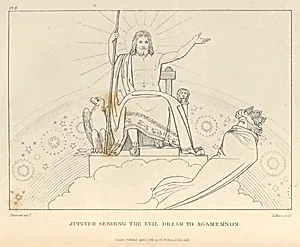
This 1834 edition of Homer’s *Iliad and the Odyssey* brings together two of the Western world’s foundational epics in a compact, illustrated volume. Published in London, the book features line engravings that translate the spare, elegant outline drawings of British neoclassical artist John Flaxman into print. Flaxman’s designs, originally created in the late eighteenth century, had already become celebrated for their clarity and classical restraint; engraver Henry Moses rendered them with crisp precision, allowing the dramatic encounters of gods, heroes, and mortals to unfold across the page. The volume also incorporates a translation by the poet and scholar William Sotheby, situating the work within the early-nineteenth-century taste for accessible yet refined editions of ancient literature. Its modest dimensions made the book suitable for private reading, reflecting a growing middle-class interest in owning finely illustrated classics. The presence of eagles among the engraved motifs underscores the epics’ recurring themes of divine intervention and heroic fate. Acquired by the Metropolitan Museum through the bequest of W. Gedney Beatty in 1941, the book preserves an important moment when neoclassical aesthetics and scholarly translation converged to reintroduce Homer’s world to new generations of readers.