
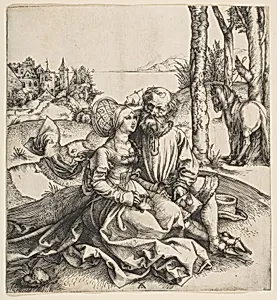
The Ill-Assorted Couple
ca. 1495
Medium
Engraving
Dimensions
sheet: 5 7/8 x 5 7/16 in. (14.9 x 13.8 cm) trimmed to plate line
Classification
Prints
Department
Drawings and Prints
Museum
Metropolitan Museum of Art, New York, NY
Credit
Fletcher Fund, 1919
Accession Number
19.73.105
Rights
Public Domain
Tags
Art Historical Context
Albrecht Dürer's *The Ill-Assorted Couple (ca. 1495) is a masterful early engraving captures a moment of wry social commentary. Created when Dürer was in his mid-20s, during his formative years in Nuremberg, this print (roughly 6 x 5 inches) depicts mismatched pair—a leering older man and a stylish young woman astride a horse—evoking proverbs about folly in love and unlikely pairings. As a cornerstone of the Northern Renaissance, Dürer's work bridged Gothic traditions with emerging Italian influences, blending meticulous detail with moralistic wit. Dürer's genius shines in his engraving technique, where he incised fine lines into a copper plate to produce rich tonal contrasts and intricate textures, from the horse's flowing mane to the woman's elaborate headdress. This print exemplifies his revolutionary approach to printmaking, elevating it from mere reproduction to high art collectible, widely disseminated across Europe. Housed in the Metropolitan Museum of Art's Drawings and Prints department, *The Ill-Assorted Couple* reflects late 15th-century German culture's fascination with everyday satire and human vices, inviting viewers then and now to chuckle at timeless follies. Its compact scale belies its enduring appeal as a window into Renaissance humor and technical bravura.
About the Artist
Albrecht Dürer · 1471–1528
Albrecht Dürer (1471–1528) stands as the preeminent figure of the Northern Renaissance and arguably the most influential artist in the history of printmaking. Born in Nuremberg on May 21, 1471, and dying in the same city on April 6, 1528, Dürer revolutionized the status of the artist in Northern Europe, transforming printmaking from a commercial craft into an independent fine art and establishing ...