
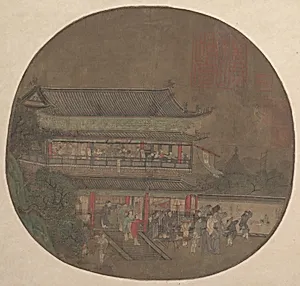
南宋/元 佚名 呂洞賓過岳陽樓圖 扇|The Immortal Lü Dongbin Appearing over the Yueyang Pavilion
late 13th–early 14th century
Medium
Fan mounted as an album leaf; ink and color on silk
Dimensions
Image: 9 3/8 × 9 7/8 in. (23.8 × 25.1 cm) Mat: 15 × 15 in. (38.1 × 38.1 cm)
Classification
Paintings
Culture & Period
China · Southern Song, Yuan or early Ming dynasty
Department
Asian Art
Museum
Metropolitan Museum of Art, New York, NY
Credit
Rogers Fund, 1917
Accession Number
17.170.2
Rights
Public Domain
Tags
Art Historical Context
Behold *The Immortal Lü Dongbin Appearing over the Yueyang*, a delicate fan painting from the late Southern Song or early Yuan dynasty (late 13th–early 14th century). Crafted by an unidentified artist using ink and color on silk this intimate work—originally a folding fan now mounted as an album leafcaptures a mythical moment: the Daoist immortal Lü Dongbin, one of China's revered Eight Immortals, ethereally above the iconic Yueyang Pavilion on Dongting Lake. Lü Dongbin, a sword-wielding scholar immortal symbolizing Taoist enlightenment and moral virtue, often appears in art as a wandering sage. Here, his supernatural visitation over the historic pavilion evokes wonder and harmony between the mortal world and the divine. The Yueyang Pavilion, immortalized in Fan Zhongyan's 11th-century prose poem *Yueyang Lou Ji*, was a cultural touchstone, representing resilience amid political turmoil during the Song-Yuan transition—a time when Daoist themes flourished amid Mongol rule. This silk medium allowed for vibrant colors and fine details, typical of elite Chinese fan art, which served as personal talismans or conversation pieces among literati. Its compact scale (9 3/8 × 9 7/8 in.) invites close contemplation, blending landscape grandeur with spiritual narrative in the Asian Art collection at The Metropolitan Museum of Art, acquired through the Rogers Fund in 1917.